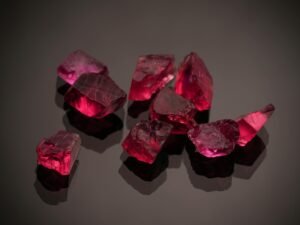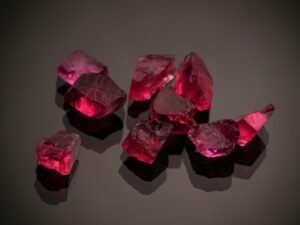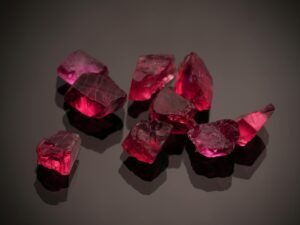

There are gemstones, and then there is the pigeon blood ruby. Few objects in the natural world provoke quite the same visceral response — that deep, luminous crimson with a faint blue undertone that seems to glow from within, as though the stone is lit by its own private fire. Collectors who have held a true pigeon blood ruby in natural light rarely forget the moment. It is the colour of passion distilled into mineral form, and it is extraordinarily, almost painfully, rare.
The term “pigeon blood” has been used by Burmese traders for centuries to describe the finest rubies emerging from the Mogok Valley — stones whose red is so saturated and so pure that early traders compared the hue to the first two drops of blood from a freshly killed pigeon, taken from directly beneath the eye. Today, the phrase carries the weight of gemmological authority. Major auction houses use it. International laboratories certify it. And serious collectors around the world pursue it with a devotion that drives prices to extraordinary heights.
At Yala Gems, we believe that understanding a gemstone deeply is the first step to owning it wisely. This guide covers everything — from the geological origins and colour science behind pigeon blood ruby, to investment considerations, pricing realities, and how to buy gemstone online with confidence. Whether you are searching for a pigeon blood engagement ring or simply expanding your knowledge, read on.
- Pigeon blood ruby is the rarest colour grade awarded to natural ruby, defined by a vivid, slightly fluorescent red with no visible secondary hues beyond a faint blue modifier.
- The Mogok Valley in Myanmar remains the most prestigious source, though fine stones also emerge from Mozambique, Vietnam, and Madagascar.
- Certified pigeon blood rubies command premiums of 300–600% over comparable non-certified red rubies of the same carat weight.
- Gemological Institute of America (GIA) and Gübelin Gem Lab are the two most trusted laboratories for pigeon blood colour origin reports.
- Singapore has emerged as one of Asia’s most trusted destinations to buy pigeon blood ruby, with strict trade regulations and a discerning collector market.
- Buying through a reputable jeweller — either in-person or when you buy gemstone online — requires certification, provenance documentation, and heat-treatment disclosure.
The Geography of Fire: Origin and Provenance
To understand pigeon blood ruby, you must first understand Mogok. Nestled in the hills of Upper Myanmar, the Mogok Valley sits within a metamorphic geological belt where ancient limestone reacted with igneous intrusions over millions of years. This process created marble-hosted corundum — rubies with a unique chemical composition low in iron, which allows their chromium content to fluoresce intensely under UV light and even under natural daylight. It is precisely this fluorescence that gives Mogok stones their legendary inner glow.
A Mogok origin certificate from Gübelin or the Swiss Gemmological Institute (SSEF) can add 40–80% to the value of an already exceptional stone. The best of these receive the additional notation “pigeon blood colour” — a designation that fewer than one in ten thousand natural rubies ever earns. The combination of Mogok origin and pigeon blood grading places a stone in a category so rarefied that it changes hands mostly at auction or through specialist private dealers.
Mozambique has emerged as the most significant alternative source since large-scale deposits were discovered in the Montepuez region around 2009. Mozambican rubies can achieve pigeon blood colour, and many do — though their iron content tends to be slightly higher than Mogok material, reducing fluorescence somewhat. Vietnam’s Luc Yen rubies and Madagascar’s Ilakaka stones round out the map of meaningful production, each with distinct inclusions and saturation profiles that experienced gemologists can identify under magnification.
Origin alone does not make a pigeon blood ruby. The designation is a colour grade, not a geographic one — and a laboratory report must explicitly state “pigeon blood colour” in its conclusion for that premium to apply commercially. Always request the full grading report, not merely an origin certificate, when evaluating a high-value natural ruby for purchase.
The Science of Pigeon Blood Colour: Grading and Quality

The pigeon blood colour standard is precise, even if its poetic name suggests otherwise. Gemologically, the grade requires a hue that sits between pure red (6R on the Munsell scale) and slightly purplish-red, with a tone in the medium-dark range and saturation classified as vivid. The colour must remain stable under both incandescent and daylight-equivalent illumination — a stone that looks brilliant under a jeweller’s lamp but turns dark and lifeless outdoors does not qualify.
Clarity plays a supporting role. Rubies are a Type II gemstone, meaning inclusions are expected and accepted. A pigeon blood designation does not require eye-clean clarity, but significant inclusions that visually disrupt the colour — particularly those that create a “silk” so heavy it dulls the surface — will work against the grade. Fine intersecting rutile needles, known as silk, can actually enhance a ruby’s glow when present in modest quantities, scattering light in a way that amplifies perceived saturation.
Cut is equally critical. Rubies are almost always cut in the country of origin to preserve weight, often resulting in a high dome and uneven proportions. A well-recut pigeon blood ruby from a respected lapidary — one that sacrifices some carat weight in exchange for ideal light return — will consistently command a higher price per carat than a heavier, poorly proportioned stone. When evaluating a pigeon blood ruby ring for sale, always examine photographs of the stone face-up in natural light, never exclusively under studio lighting.
“A pigeon blood ruby at its finest is not simply red. It is red with purpose — a colour so intentional it seems less like geology and more like alchemy.”
Pricing and Investment Value: What Collectors Need to Know
Pigeon blood ruby price is not a single figure — it is a matrix of variables that intersect at a unique point for every stone. Carat weight is the most obvious driver, and ruby follows an exponential rather than linear pricing curve. A one-carat pigeon blood ruby from Mogok, unheated and certified, might trade between USD 8,000 and USD 20,000 per carat at retail. At three carats, that range extends to USD 30,000–80,000 per carat. At five carats and above, the ceiling becomes largely theoretical.
Heat treatment is the single most significant value dividing line in the market. The majority of commercial rubies — perhaps 95% — have been heat-treated to dissolve silk, improve clarity, and intensify colour. An unheated pigeon blood ruby with a “no indications of heating” notation on its laboratory report commands a substantial premium over a heated stone of identical appearance, sometimes 200–400% more at the top of the market. For investment purposes, unheated certification is non-negotiable.
| Carat Weight | Origin | Treatment | Est. Retail Price (USD/ct) |
|---|---|---|---|
| Under 1 ct | Mozambique | Heated | 2,000 – 5,000 |
| 1–2 ct | Mozambique | Unheated | 6,000 – 15,000 |
| 1–2 ct | Mogok, Myanmar | Heated | 10,000 – 22,000 |
| 1–2 ct | Mogok, Myanmar | Unheated | 20,000 – 50,000 |
| 3–5 ct | Mogok, Myanmar | Unheated | 40,000 – 100,000+ |
From a collector investment standpoint, pigeon blood ruby has outperformed natural sapphire and most coloured gemstones over the past two decades at the top auction tier. Christie’s and Sotheby’s records for per-carat ruby prices consistently break previous records, with Mogok unheated specimens above five carats now achieving figures that rival high-quality diamonds. Liquidity is more limited than for diamonds, but within the specialist coloured stone community, a certified pigeon blood ruby with full provenance is among the most accepted stores of portable, appreciating value available.
When comparing pigeon blood ruby against a natural sapphire or other precious stones for portfolio purposes, consider that ruby above three carats is statistically rarer than diamond at equivalent quality thresholds. Supply from Mogok has not meaningfully increased in decades, while demand from Chinese, Southeast Asian, and Middle Eastern collectors continues to accelerate. Scarcity fundamentals remain exceptionally strong.
Singapore: Asia’s Premier Destination for Fine Rubies

Singapore occupies a unique position in the global coloured gemstone trade. Its combination of transparent import regulations, a sophisticated collector base, geographical proximity to major ruby-producing regions, and a thriving luxury retail scene make it one of the most reliable places in Asia to source exceptional stones. For buyers seeking pigeon blood ruby Singapore is not merely convenient — it is strategically advantageous.
The city-state’s gemstone retailers operate under strict consumer protection frameworks, and reputable boutiques maintain relationships with international laboratories, ensuring that laboratory-certified stones are the standard rather than the exception. Unlike some regional markets where grey-area treatments and undisclosed enhancements remain common, Singapore’s fine jewellery community has largely aligned itself with global best practices on disclosure and documentation. This matters enormously when you are considering a pigeon blood ruby ring that may represent a six-figure investment.
At Yala Gems, our curated selection of natural ruby and other precious coloured stones reflects the discernment our clients bring to every purchase. We source directly and work exclusively with certified stones, ensuring that every gemstone ring leaving our boutique carries the documentation its value demands. If you are looking for where to buy pigeon blood ruby in Singapore with full confidence, we encourage you to speak with our gemologists directly.
How to Buy Gemstone Online Safely: A Practical Framework
The digital marketplace for fine gemstones has matured significantly, and it is now entirely possible to buy gemstone online with the same confidence you would have walking into a respected boutique — provided you follow a rigorous process. The risks are real but manageable, and the rewards of online access to a wider selection at competitive pricing make the effort worthwhile for serious buyers.
The first and most important rule is to require a current laboratory report from GIA, Gübelin, SSEF, or Lotus Gemology for any ruby above one carat. The report must accompany the stone, not merely be referenced by number — verify the report independently on the laboratory’s online portal before completing any transaction. For pigeon blood colour specifically, confirm that the exact phrase appears in the report’s colour origin section, not merely in a dealer’s description.
Second, request video footage in multiple lighting conditions — daylight, incandescent, and ideally natural outdoor light. A true pigeon blood ruby will glow and intensify in daylight; a stone that only performs under warm artificial lighting is revealing something important about its colour grade. Most established online jewellers will provide this readily. If a seller declines, treat that as a firm disqualifying signal.
Third, understand the returns policy before purchasing. Reputable platforms that carry certified natural gemstone inventory will offer inspection periods of at least seven to fourteen days, during which you may have the stone independently appraised. A seller unwilling to allow independent assessment should not receive your business. For high-value pieces — particularly a pigeon blood engagement ring — we always recommend speaking with our gemologists before finalising any online purchase, whether from us or elsewhere. An informed buyer is always a protected buyer.
Styling the Stone: Rings, Settings, and Occasions
The pigeon blood ruby ring is among the most powerful jewellery statements in any collection. Its colour carries inherent formality and intensity, yet the right setting can modulate that energy across a remarkable range of occasions. For a pigeon blood engagement ring, the most enduring choice remains a classic oval or cushion-cut stone in a platinum or 18-carat white gold solitaire, where the metal’s cool neutrality amplifies the ruby’s warmth without competing with it.
Yellow gold settings create a more antique, regal aesthetic — think Mughal-inspired pieces or Victorian revival designs where the ruby sits within a framework of old-cut diamonds and hand-engraved metalwork. This pairing has seen a strong revival among younger collectors who favour warmer, more characterful jewellery over the minimalism of the past two decades. Rose gold occupies a middle ground: romantic and contemporary, but occasionally risky, as the metal’s pink warmth can slightly muddy a pigeon blood ruby’s blue-toned red when viewed in certain lights.
For the pigeon blood ruby ring men’s market — a growing segment in Singapore and across Asia — the stone performs exceptionally well in signet-style settings, bezel mounts, and substantial cocktail ring formats. A five-millimetre round pigeon blood ruby flanked by black diamonds in a brushed platinum mounting reads as authoritative and entirely masculine. The stone’s cultural associations with power, protection, and prosperity across multiple Asian traditions make it a natural fit for a clientele that values meaning alongside aesthetics in a gemstone ring.
Frequently Asked Questions
Final Thoughts
The pigeon blood ruby occupies a place in the gemstone hierarchy that no other stone quite rivals. Its colour is not merely attractive — it is irreducible. There is no synthetic, no simulant, no clever setting that fully replicates the particular quality of light inside a true pigeon blood natural ruby from Mogok. That irreplaceability is what sustains both its romance and its remarkable financial trajectory.
For collectors and connoisseurs in Singapore and across Southeast Asia, the current moment is a meaningful one. Access to certified, documented stones has never been better, and the frameworks for buying safely — whether in-person or when you buy gemstone online — have never been more robust. The challenge is no longer finding information; it is having the expertise to act on it wisely.
Whether you are beginning a lifelong pursuit of fine coloured stones or seeking a single, transformative piece — a pigeon blood engagement ring that will carry weight across generations, or a gemstone ring that quietly anchors a serious collection — the guidance of specialists who understand both the science and the soul of these stones is invaluable. We are here when you are ready.
Discover Exceptional Natural Rubies at Yala Gems
From certified pigeon blood rubies to bespoke gemstone rings — our Singapore boutique offers expert guidance at every step of your journey.