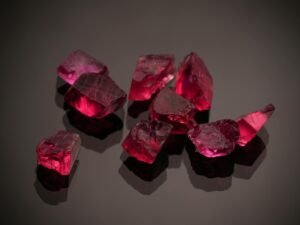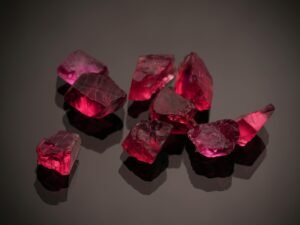

There are gemstones, and then there is the pigeon blood ruby. Of all the natural gemstone varieties coveted by collectors, monarchs, and connoisseurs across centuries, none commands quite the same reverence — or the same breathless pause at the jeweller’s loupe — as a certified pigeon blood red ruby of Burmese origin. The colour is not merely red. It is a living, pulsing crimson that seems to generate its own inner fire, as though the stone has absorbed every sunset it has ever witnessed and refuses to surrender a single ray.
In gemological circles, the designation “pigeon blood” is far more than a poetic descriptor. It is a precisely graded, internationally recognised quality standard applied only to rubies exhibiting a very specific hue: a pure, vivid red with the faintest blue undertone, saturated to the point of intensity without tipping into darkness. The term originates from the Burmese trade tradition, where the colour was compared to the first two drops of blood from a freshly killed pigeon — bright, slightly violet-tinged, and luminous. Only a fraction of rubies mined globally ever achieve this classification, and of those, even fewer emerge from the earth without fractures, inclusions, or treatments that diminish their value.
At Yala Gems, our Singapore boutique has spent years building relationships with trusted sources across the ruby-producing regions of the world, precisely because we understand that acquiring a pigeon blood ruby is not a transaction — it is a pursuit. This guide is written to honour that pursuit: to educate, to inspire, and to ensure that when you are ready to buy, you do so with the clarity and confidence that a stone of this magnitude deserves.
- Pigeon blood is the highest colour grade in ruby evaluation, defined by a pure vivid red with a slight blue fluorescence and exceptional saturation.
- The Mogok Valley in Myanmar remains the most prestigious source, though significant finds also come from Mozambique and Vietnam.
- Pigeon blood ruby price is driven by a combination of colour grade, carat weight, clarity, origin, and the presence or absence of heat treatment.
- Unheated, certified pigeon blood rubies of fine quality routinely outperform diamonds and coloured sapphires at international auction.
- Buyers in Singapore benefit from access to a concentrated market of reputable dealers and gemological certification services in the region.
- When you buy gemstone online, insist on third-party laboratory certificates from GIA, Gübelin, or SSEF, and always request provenance documentation.
Origin and Provenance: Where Pigeon Blood Rubies Come From
The geography of a pigeon blood ruby is inseparable from its value. Myanmar’s Mogok Valley — known for centuries as the “Valley of Rubies” — remains the gold standard of ruby provenance. The marble-hosted deposits there produce stones with a chemical composition that encourages strong red fluorescence under both natural and ultraviolet light, amplifying the apparent colour in a way that rubies from other locations rarely replicate. A Mogok pigeon blood ruby does not simply reflect red light; it radiates it.
Vietnam’s Luc Yen and Quy Chau regions emerged in the late twentieth century as secondary sources capable of producing gem-quality stones approaching pigeon blood standards, though typically with slightly stronger purple overtones. Mozambique’s Montepuez deposit, discovered in 2009, has since reshaped the commercial ruby market entirely, producing stones of exceptional size and, in finest quality, pigeon blood colour grades that have earned recognition from the world’s leading gemological laboratories. The critical distinction for collectors is that Mozambican rubies often carry a higher iron content, which can subtly suppress fluorescence — a point that separates a very fine ruby from an undeniable pigeon blood specimen.
Provenance documentation matters profoundly when you invest at this level. Reputable sellers, including our team at Yala Gems, will always provide country-of-origin opinions from internationally accredited laboratories alongside any significant pigeon blood ruby offered for sale.
The term “pigeon blood” was formally codified into gemological standards relatively recently, with laboratories like Gübelin Gem Lab, SSEF Swiss Gemmological Institute, and the GIA all developing proprietary but broadly aligned criteria for its application. A certificate bearing the explicit words “pigeon blood colour” from any of these three institutions represents the highest form of independent colour validation available. Without such a certificate, the phrase remains commercial language — meaningful in conversation, but unverifiable on the secondary market.
Quality Evaluation: How Pigeon Blood Colour Is Graded

Understanding pigeon blood colour requires separating it from the broader concept of “red ruby.” Every ruby is red by definition — it is the presence of chromium that creates the colour — but not every red ruby achieves pigeon blood status. The grading involves four interrelated factors: hue, tone, saturation, and fluorescence. The ideal pigeon blood ruby displays a hue of pure red with no more than a minor blue secondary, a medium to medium-dark tone that preserves brightness, and a saturation so intense that gemologists describe it as “vivid” on standardised colour scales.
Fluorescence plays a unique and often underappreciated role. High-quality Mogok rubies exhibit strong red fluorescence under long-wave ultraviolet light, a property that causes the stone to appear even more luminous in daylight — which itself contains UV components. This self-illuminating quality is one reason pigeon blood rubies look distinctly alive on the hand when set in a pigeon blood engagement ring worn in natural Singapore daylight, compared with the same stone viewed under artificial lighting in a controlled environment.
Clarity considerations follow the colour assessment. Unlike diamonds, where flawless clarity is a meaningful benchmark, rubies are Type II gemstones and virtually always contain inclusions. The standard for pigeon blood rubies is “eye-clean” — no inclusions visible to the naked eye — while accepting that magnification will reveal the characteristic silk (fine rutile needles) that can actually enhance a stone’s glow when present in moderate quantities.
| Quality Factor | Pigeon Blood Standard | Commercial Ruby Standard |
|---|---|---|
| Hue | Pure red, slight blue modifier only | Red to orange-red or purple-red |
| Saturation | Vivid — maximum without darkening | Moderate to strong |
| Tone | Medium to medium-dark | Light to dark range acceptable |
| Fluorescence | Strong red UV fluorescence preferred | Variable, not a primary criterion |
| Treatment | Unheated commands significant premium | Heat treatment widely accepted |
| Certification | GIA, Gübelin, or SSEF essential | Varies by price point |
Collector and Investment Value: Why Pigeon Blood Rubies Appreciate
Fine pigeon blood rubies occupy a category that few natural gemstone types can claim: a market with demonstrably constrained supply and persistently rising demand. The Mogok mines have been operating for over a thousand years. They are not getting younger, and the finest material — the unheated, certified pigeon blood specimens above two carats — is becoming genuinely scarce. When supply is geological and demand is human, the long-term value trajectory is not difficult to predict.
At major auction houses, the evidence is unambiguous. Record per-carat prices for coloured gemstones have, in recent decades, been set repeatedly by pigeon blood rubies — surpassing even the finest natural sapphire lots and exceptional Colombian emeralds. The Sunrise Ruby, a 25.59-carat Mogok pigeon blood stone, achieved over USD 30 million at Sotheby’s in 2015, setting a world record for any ruby or coloured gemstone at auction. While such exceptional pieces are beyond most collectors, the underlying market dynamics that produced that result apply all the way down the quality spectrum.
Investors treating pigeon blood rubies as a portfolio asset should understand that liquidity differs from equities or real estate. The market for exceptional stones is relationship-driven and specialist. This is precisely why working with an established gemstone singapore authority — one with access to certified inventory and knowledge of the resale ecosystem — is not optional. It is foundational to a sound acquisition strategy.
“A pigeon blood ruby of fine quality is one of the very few portable, wearable assets that combines aesthetic supremacy with genuine rarity. It is wealth you can hold in your hand — and wear to dinner.”
Singapore as a Premier Destination for Ruby Collectors

Singapore occupies a uniquely advantageous position in the global coloured gemstone trade. Geographically, it sits at the convergence of supply routes from Myanmar, Sri Lanka, Mozambique, and Thailand — historically the world’s primary ruby treatment hub. Economically, it offers a stable, transparent regulatory environment with no import duties on precious gemstones, making the landed cost of acquiring certified stones highly competitive. Culturally, Singapore has cultivated a sophisticated collector base that demands the same standards of authentication and documentation as buyers in Geneva or New York.
For anyone searching for pigeon blood ruby Singapore sources, the city-state offers something increasingly rare in the global market: the ability to physically inspect a stone before purchase, alongside the infrastructure of internationally accredited grading laboratories accessible within the region. The combination of tactile access and third-party verification is, for a gemstone at this price point, irreplaceable.
At Yala Gems, we work exclusively with rubies accompanied by certificates from the world’s leading laboratories. Our clients range from first-time collectors acquiring a one-carat pigeon blood ruby ring as an heirloom to experienced investors seeking unheated Mogok specimens above five carats. In every case, the conversation begins the same way: with education, transparency, and the stone itself on the table.
Singapore’s GST framework for investment-grade precious metals exempts qualifying items, and while gemstones do not carry the same blanket exemption, the absence of import tariffs still makes acquiring a pigeon blood ruby here meaningfully more cost-effective than in many Western markets where import duties and VAT apply. Combined with the concentration of specialist dealers and the proximity to origin countries, Singapore consistently ranks among the world’s most favourable environments for acquiring fine coloured gemstones.
How to Buy Gemstone Online Safely: A Pigeon Blood Ruby Checklist
The digital marketplace for coloured gemstones has matured considerably, but the pigeon blood ruby category demands a level of due diligence that exceeds most online purchases. When you buy gemstone online at this level, the certificate is not a supplementary document — it is the primary asset. A ruby described as pigeon blood without independent laboratory verification is, for all practical purposes, a ruby described as pigeon blood by the person selling it to you. That circular logic should be rejected immediately.
Begin every evaluation by confirming which laboratory issued the certificate. GIA, Gübelin Gem Lab, and SSEF are the three institutions whose pigeon blood colour designations carry universal market recognition. The Asian Institute of Gemological Sciences (AIGS) and Gem Research Swisslab (GRS) are respected alternatives, with GRS in particular having a strong foothold in the Southeast Asian trade. Any certificate from an unfamiliar institution warrants independent verification before proceeding.
Next, confirm the treatment status. A natural ruby described as unheated commands a premium of anywhere from 30 to 300 percent over a comparable heated stone, depending on size and quality. This is not a minor distinction. Reputable sellers will state treatment status explicitly and in writing. If the listing is ambiguous, that ambiguity is itself a disqualifying signal. You are always welcome to speak with our gemologists before committing to any significant purchase — a conversation costs nothing and can prevent an expensive mistake.
Finally, insist on a return policy supported by third-party appraisal rights. Any serious merchant offering a natural gemstone at pigeon blood price levels should have no objection to a buyer having the stone independently assessed within a defined window. Those who resist this condition are telling you something important.
Understanding Pigeon Blood Ruby Price: What You Should Expect to Pay
Pigeon blood ruby price varies across an extraordinary range, and understanding the drivers of that variance is essential before entering the market. At the entry level, a certified pigeon blood ruby under one carat — heated, eye-clean, with good colour but no exceptional provenance — might be acquired for SGD 3,000 to 8,000 per carat from a reputable gemstone singapore dealer. This represents a meaningful quality level entirely appropriate for a fine pigeon blood ruby ring or pigeon blood engagement ring intended for daily wear.
As carat weight increases, price per carat escalates non-linearly. A two-carat pigeon blood ruby of comparable quality might command SGD 12,000 to 25,000 per carat, because stones of this size with maintained colour are genuinely uncommon. Above three carats, the market enters rarefied territory: unheated Mogok specimens with strong laboratory certification regularly transact above SGD 50,000 per carat, with exceptional examples at fine carat weights reaching multiples of that figure.
The decision to buy gemstone online versus in-person becomes particularly consequential at higher price points. For stones above SGD 20,000, we would always recommend an in-person viewing — either at our boutique or through an arranged viewing facilitated by our team. The colour of a pigeon blood ruby must be experienced under varied lighting conditions to be properly evaluated, and no screen, however colour-calibrated, fully replicates that experience.
Frequently Asked Questions
Final Thoughts
The pigeon blood ruby represents something increasingly rare in a world of reproductions and synthetic alternatives: a natural gemstone so demanding in its requirements, so constrained in its supply, and so extraordinary in its beauty that it has retained its status as the ultimate prize in coloured gemstone collecting for centuries without interruption. Its colour is not a trend. Its rarity is not manufactured. Its value is not speculative in the way of volatile assets — it is grounded in the irreversible geology of a few specific valleys and the chromium content of ancient marble.
Whether you are considering your first pigeon blood ruby ring, seeking an unheated Mogok specimen to anchor a serious collection, or exploring a pigeon blood engagement ring as an expression of singular commitment, the principles of a sound acquisition remain constant: prioritise certification, understand the price drivers, source from reputable dealers, and never allow enthusiasm to outpace due diligence. The stone will be with you — and potentially your descendants — for generations. It deserves that level of care in its selection.
Singapore offers one of the world’s most favourable environments for making this acquisition wisely. And within Singapore, Yala Gems remains committed to making the experience not just reliable, but genuinely extraordinary.
Ready to Find Your Pigeon Blood Ruby?
Explore our curated collection of certified natural rubies, or speak with our gemologists for personalised guidance on acquiring a stone of this exceptional calibre.