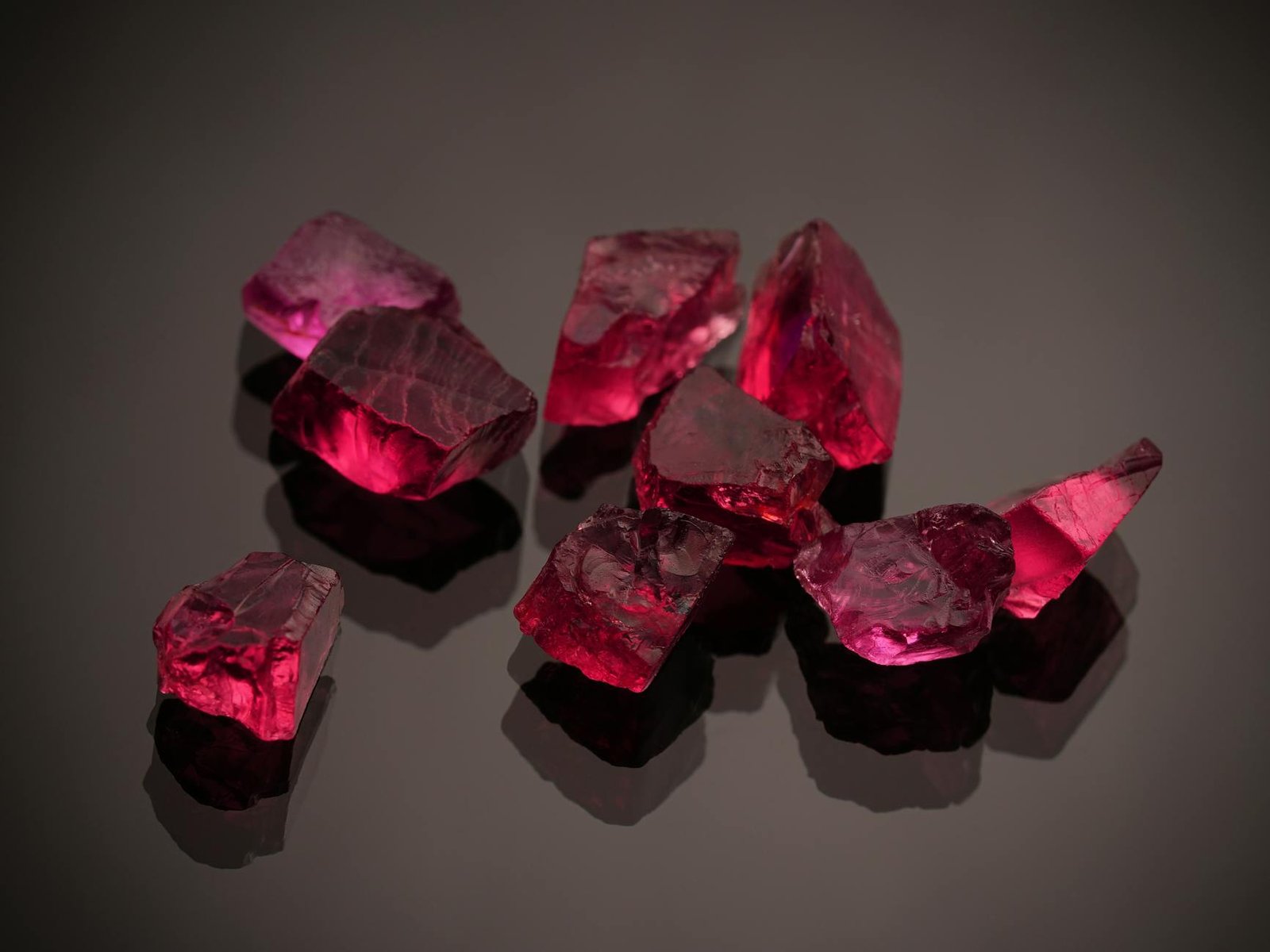
There is a colour that exists at the very edge of human desire — a red so saturated, so luminous, so alive with inner fire that gemologists have spent centuries searching for the right words to describe it. They settled, poetically, on pigeon blood. The term conjures something visceral and precise: the vivid, slightly blue-tinged crimson visible at the centre of a freshly opened wound from a white pigeon, pure and unapologetic in its intensity. In the world of coloured gemstones, no standard is more coveted, more debated, or more financially significant than this single evocative phrase.
A true pigeon blood ruby is not merely a red stone. It is a natural gemstone that has achieved a near-mythological status among collectors, connoisseurs, and romantics alike. The finest examples originate from the legendary Mogok Valley in Myanmar — a name that carries the same reverence among gem traders as Bordeaux does among vintners. These stones possess a quality of light that seems almost self-generated, as though the ruby is illuminated from within rather than simply reflecting what falls upon it. That phenomenon, caused by the interplay of chromium fluorescence and iron content, is what separates a pigeon blood ruby from every other red stone on earth.
At Yala Gems, we have built our reputation on precisely this kind of rarity. Our gemologists travel, study, and authenticate with a singular purpose: to bring stones of genuine significance to clients who understand that true luxury is not manufactured — it is discovered. This guide is your definitive resource for understanding the pigeon blood ruby, from its geological origins to its place as the most prestigious gemstone Singapore collectors can acquire.
- Pigeon blood is the highest colour grade assigned to a natural ruby, defined by a vivid, pure red with a subtle blue undertone and exceptional fluorescence.
- The most prized pigeon blood rubies originate from Myanmar’s Mogok Valley, though fine examples also emerge from Mozambique and Vietnam.
- Colour, clarity, fluorescence, and origin certification combine to determine pigeon blood ruby price, with top specimens routinely exceeding $1 million USD per carat at auction.
- International grading laboratories — GRS, Gübelin, and SSEF — are the only authorities whose pigeon blood designations are universally accepted by the trade.
- Singapore has become one of Asia’s most important markets for acquiring rare coloured gemstones, with discerning buyers seeking both certified stones and bespoke jewellery.
- Buying from a reputable gemstone Singapore specialist, with full provenance documentation and laboratory certification, is the only safe path to a genuine acquisition.
Where Pigeon Blood Rubies Come From
The story of the pigeon blood ruby is, at its heart, a story of geology made magnificent over millions of years. Rubies are a variety of corundum — aluminium oxide — whose red colour is produced by the presence of chromium. But chromium alone does not create the pigeon blood phenomenon. The precise balance of chromium concentration, low iron content, and the marble-hosted geological environment of specific deposits produces the fluorescence that gives these stones their legendary warmth and glow.
Mogok, in northern Myanmar, remains the supreme origin. The valley has yielded rubies for over a thousand years, and its unique geological conditions — crystalline marble with negligible iron interference — allow chromium to express itself with unimpeded brilliance. When ultraviolet light, or even strong daylight, strikes a Mogok pigeon blood ruby, the stone seems to intensify rather than simply reflect, a quality gemologists call “strong to very strong fluorescence.” This is the characteristic that separates a Mogok stone from nearly all competitors.
Mozambique has emerged since the late 2000s as a significant alternative source. The Montepuez deposit produces rubies of impressive size and saturation, and a small percentage achieve pigeon blood grading. However, the higher iron content typical of Mozambican material slightly suppresses fluorescence, producing a different — though still magnificent — quality of red. Vietnam’s Luc Yen region and Mong Hsu in Myanmar contribute additional fine material, each with its own subtle spectral signature that trained gemologists can identify through advanced spectroscopic analysis.
Origin determination has become one of the most scientifically rigorous disciplines in modern gemmology. Laboratories such as GRS (Gemmological Research Switzerland), Gübelin Gem Lab, and SSEF use laser ablation mass spectrometry and photoluminescence mapping to distinguish Mogok rubies from other sources with extraordinary precision. For a pigeon blood ruby, an accompanying origin report from one of these three institutions is not a luxury — it is a prerequisite for serious investment.
How Pigeon Blood Ruby Quality Is Evaluated

The term “pigeon blood” is not a marketing invention. It is a trade designation with increasingly formalised criteria, assessed across several interconnected dimensions. Understanding these criteria is essential before you buy pigeon blood ruby at any price point, whether you are acquiring a modest accent stone or a significant collector piece.
Colour is the paramount factor. The pigeon blood standard requires a hue that sits in the pure red to slightly purplish-red range, with a tone that is neither too dark nor too light. Saturation must be vivid — the GRS laboratory defines it formally as “vivid red” with the pigeon blood notation reserved for stones that additionally demonstrate strong fluorescence and no brownish or orangey modifiers. This is a narrow target, and the majority of natural rubies never reach it regardless of their origin.
Clarity in rubies follows a different logic than in diamonds. Some inclusions — particularly the fine rutile silk that creates asterism in star rubies — are expected and even valued. In a faceted pigeon blood ruby, however, clarity should be “eye clean” at minimum, meaning no inclusions are visible to the unaided eye under normal viewing conditions. Needles, fingerprints, and fractures that reach the surface significantly reduce both beauty and durability.
Cut quality is frequently underestimated by buyers. A fine pigeon blood ruby must be cut to maximise the return of red light through the table facet, avoiding the “windowing” effect — a pale, washed-out zone in the stone’s centre — that results from a shallow pavilion. The finest cutters in Thailand and Sri Lanka are masters of this balance, and their work commands a measurable premium.
| Origin | Fluorescence | Typical Iron Content | Pigeon Blood Potential | Relative Price Premium |
|---|---|---|---|---|
| Mogok, Myanmar | Very Strong | Very Low | Highest | +++ Maximum |
| Luc Yen, Vietnam | Strong | Low | High | ++ Significant |
| Montepuez, Mozambique | Moderate | Moderate | Moderate | + Moderate |
| Mong Hsu, Myanmar | Moderate–Strong | Low–Moderate | Moderate–High | ++ Moderate–Significant |
Collector and Investment Value
Among coloured gemstones, the pigeon blood ruby occupies a category that few natural gemstones share — it has demonstrated consistent, multi-decade price appreciation that outperforms many traditional asset classes. The auction record for a ruby stands at over $1.18 million USD per carat, achieved by the Sunrise Ruby at Sotheby’s Geneva in 2015, a 25.59-carat Mogok stone with a GRS pigeon blood designation. That benchmark remains one of the most significant moments in the history of coloured stone collecting.
The investment case for pigeon blood rubies rests on several structural factors. Supply from Mogok is genuinely finite and declining, with the most productive seams largely exhausted after generations of mining. Political and regulatory constraints on Myanmar’s gem trade have further restricted the flow of certified Mogok material into international markets. Meanwhile, demand from ultra-high-net-worth buyers in Asia — particularly from Singapore, Hong Kong, and mainland China — continues to grow as wealth creation accelerates and buyers seek tangible, portable stores of value.
“A fine pigeon blood ruby from Mogok is not simply a gemstone. It is a crystallised epoch — a convergence of geological rarity, human artistry, and cultural longing that no financial instrument can replicate.”
For buyers considering a pigeon blood ruby ring as a long-term acquisition, the stone’s durability reinforces its investment credentials. At a hardness of 9 on the Mohs scale, ruby is exceeded only by diamond, making it genuinely suitable for daily wear in a pigeon blood engagement ring or statement ring without the fragility concerns associated with softer coloured stones such as emerald or tanzanite. This combination of aesthetic supremacy and physical resilience is rare across the entire gemstone spectrum — even the most celebrated natural sapphire cannot claim the same chromatic intensity at the top of its grading range.
Treatment disclosure is a non-negotiable element of responsible ruby acquisition. The vast majority of rubies on the global market have been heat-treated to improve colour and clarity — a widely accepted practice that does not dramatically suppress value when properly disclosed. However, unheated pigeon blood rubies of significant size carry a substantial additional premium, sometimes 30 to 50 percent above equivalent heated examples. Always confirm treatment status through your laboratory certificate before completing any purchase.
Singapore as a Premier Destination for Rare Rubies

Singapore has earned its place as one of Asia’s most trusted centres for fine coloured gemstone acquisition, and the city-state’s advantages are structural rather than incidental. Its position as a free-trade port means that import duties on loose gemstones are effectively zero, reducing the acquisition cost premium that buyers face in markets such as India or Thailand. More significantly, Singapore’s robust legal framework and culture of commercial transparency create an environment where provenance documentation and laboratory certification are respected and enforced.
For buyers seeking pigeon blood ruby Singapore options, the local market offers something that online platforms rarely can: the opportunity to examine stones under controlled lighting conditions, in dialogue with a qualified gemologist who can explain precisely what the laboratory certificate confirms. The pigeon blood colour is a quality that must be experienced in person — photographs, even excellent ones, consistently fail to capture the fluorescent warmth that defines the grade. A reputable gemstone Singapore specialist will always invite comparison viewing and provide supporting documentation without hesitation.
At Yala Gems, our Singapore boutique maintains direct relationships with trusted suppliers across the primary ruby-producing regions, ensuring that every stone we present carries transparent provenance and relevant laboratory certification. Whether you are seeking a pigeon blood engagement ring Singapore clients will wear for generations, or a loose certified stone for a private collection, our curation process applies the same exacting standards. We encourage every prospective buyer to speak with our gemologists before making any significant decision.
How to Buy a Pigeon Blood Ruby Safely — Online and In Person
The rise of digital platforms has created extraordinary access to coloured gemstone inventory that was once available only to trade insiders. It is now genuinely possible to buy gemstone online at a competitive pigeon blood ruby price, provided you approach the process with rigorous due diligence. The risks are real — misrepresentation, undisclosed treatment, synthetic substitutes, and inflated valuations are documented problems across unregulated online gem marketplaces — but they are entirely manageable when you know what to require.
The first and most important rule is certification. Accept no pigeon blood claim without a current certificate from GRS, Gübelin, or SSEF. These three laboratories are the international standard-bearers for ruby grading, and their pigeon blood notation carries legal and commercial weight that no seller’s word can replicate. When you buy gemstone online, the certificate reference number should be verifiable directly on the issuing laboratory’s website before any payment is transferred.
Treatment transparency is the second non-negotiable. Ask explicitly whether the stone is heated or unheated, and verify this against the certificate. Reputable sellers will provide this information proactively and price accordingly. If a seller is vague or evasive on the question of heat treatment, that is a clear signal to pause and reassess.
Third, consider the return and authentication policy. A trustworthy seller — whether a physical boutique or a platform offering pigeon blood ruby ring for sale — will allow independent verification by a qualified gemologist of your choosing. If a seller resists third-party verification, the transaction carries unacceptable risk regardless of the price offered. Our team is always available to speak with our gemologists about evaluating any stone you are considering, even if it was not sourced through us.
Frequently Asked Questions
Final Thoughts
The pigeon blood ruby is, without qualification, one of the most remarkable objects the natural world produces. It combines geological improbability, aesthetic perfection, and enduring cultural significance into a stone small enough to hold between two fingers and yet capable of commanding prices that rival real estate. For anyone who has stood under gallery lighting and watched a fine Mogok ruby seem to breathe with its own internal fire, the obsession is entirely understandable.
Whether you are approaching this gemstone as a serious collector, a prospective groom searching for the most meaningful pigeon blood engagement ring available, or simply a lover of rare and beautiful things, the same principles apply: prioritise certification from the recognised international laboratories, demand full treatment disclosure, and work only with specialists whose reputation is built on transparency and expertise.
Singapore’s position as a sophisticated, transparent gemstone market makes it an ideal environment for this kind of acquisition. The combination of zero import duty, strong legal protections, and a growing community of knowledgeable collectors has made buy pigeon blood ruby Singapore one of the most searched phrases among serious gem buyers across Southeast Asia — and for good reason. When you are ready to explore what is available, our team at Yala Gems is here to guide every step of that journey with the care and expertise that a stone of this calibre deserves.
Discover Certified Pigeon Blood Rubies at Yala Gems
Explore our curated knowledge hub for expert guides on natural gemstones, ruby grading, and how to buy with confidence in Singapore and beyond.