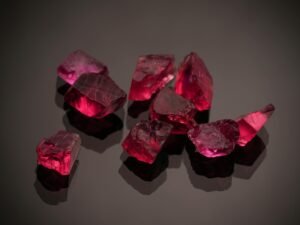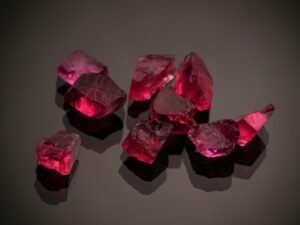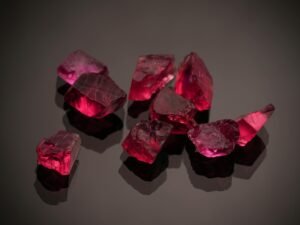

There is a shade of red so precise, so electrically alive, that the entire gemstone world has built a legend around it. The pigeon blood ruby is not simply a coloured stone — it is a chromatic event. Named for the vivid, slightly bluish-red hue said to resemble the first two drops of blood from a freshly sacrificed Burmese pigeon, this designation represents the absolute pinnacle of ruby grading, reserved for stones whose colour saturation, tone, and fluorescence align in a near-impossible convergence of natural forces.
To own a genuine pigeon blood red ruby is to possess something that the earth produces in vanishingly small quantities. The mines of Myanmar’s Mogok Valley — known for centuries as the Valley of Rubies — have yielded these extraordinary stones for over a thousand years, yet truly exceptional examples remain profoundly scarce. At major auction houses, a fine pigeon blood ruby regularly commands prices that surpass even the most celebrated diamonds on a per-carat basis, a testament to the sheer force of their rarity and desirability.
At Yala Gems, Singapore’s premier destination for responsibly sourced coloured stones, we have spent years studying, acquiring, and presenting these extraordinary rubies to discerning collectors and couples seeking something genuinely irreplaceable. This guide is our most complete editorial on the subject — exploring provenance, grading, investment value, and how to navigate the market with confidence.
- Pigeon blood is the highest colour grade a ruby can receive, defined by a vivid, slightly bluish-red hue with strong red fluorescence and minimal secondary tones.
- The finest pigeon blood rubies originate from Mogok, Myanmar, though exceptional stones are also sourced from Mozambique and Vietnam.
- Certification from GRS, Gübelin, or SSEF is essential — these are the only laboratories that formally issue a “pigeon blood” colour origin notation on a ruby report.
- Pigeon blood ruby ring prices in Singapore range from SGD 5,000 for smaller commercial-quality stones to well over SGD 500,000 for certified Mogok specimens above three carats.
- A pigeon blood engagement ring represents one of the most emotionally resonant and financially sound choices in fine jewellery today.
- Buying a natural gemstone online safely requires verifiable certification, transparent provenance documentation, and a trusted retailer with a physical presence.
Where Pigeon Blood Rubies Come From
The story of the pigeon blood ruby is, above all, a story of place. The Mogok Stone Tract in upper Myanmar sits at an elevation where marble-hosted corundum deposits formed under geological conditions that have never been precisely replicated elsewhere on Earth. The chromium content in Mogok rubies, combined with low iron levels, produces the characteristic vivid red with a warm fluorescent glow that defines the pigeon blood colour standard.
For centuries, Mogok supplied virtually all of the world’s finest rubies. Royal courts from Mandalay to Mughal India prized these stones above all others. Even today, a certified Mogok origin adds a significant premium — often 30 to 50 percent — over rubies of identical colour from other localities. The designation “Burma ruby, no heat” on a laboratory certificate remains among the most powerful phrases in the coloured gemstone trade.
Mozambique entered the fine ruby conversation in earnest around 2009, when the Montepuez deposit began producing stones of remarkable quality. While Mozambican rubies can achieve pigeon blood colour grades, connoisseurs and collectors generally continue to favour Mogok origin for historic and cultural reasons. Vietnam’s Luc Yen region produces a smaller volume of high-quality rubies with similar chromium chemistry, occasionally reaching pigeon blood standards.
Provenance is not merely a romantic detail — it is a quantifiable value driver. In our experience at Yala Gems, a certified unheated Mogok ruby at 2 carats with a pigeon blood notation will typically sell for two to three times the price of a chemically identical stone from Mozambique. When you buy gemstone online or in person, always request the full laboratory report and confirm that origin determination was performed alongside colour grading. The two findings are inseparable for serious investment pieces.
Understanding Pigeon Blood Colour and Quality Grading

The term pigeon blood colour has been used poetically in the gem trade for generations, but it gained formal scientific definition when the Swiss Gemmological Institute (SSEF) and Gübelin Gem Lab began issuing standardised colour notations on ruby reports in the early 2000s. Today, three laboratories — GRS, Gübelin, and SSEF — are recognised as authoritative for pigeon blood designations, and collectors should accept reports from no others for stones at this price level.
To qualify, a ruby must display a hue position between slightly purplish-red and pure red, with a tone in the medium to medium-dark range and saturation described as vivid. Critically, the stone must exhibit strong red fluorescence under ultraviolet light, which causes the colour to appear to glow from within — this is the quality that separates a great pigeon blood ruby from a merely excellent one. Secondary modifying colours such as orange or purple should be minimal to absent.
Beyond colour, the evaluation of a pigeon blood ruby follows the same four pillars as any natural ruby: cut, clarity, carat weight, and treatment status. Heat treatment is common practice in the ruby trade and accepted by the market, but unheated stones of pigeon blood quality command a substantial premium. Clarity inclusions — rutile needles, fingerprint-like fluid inclusions, and growth zoning — are expected in natural corundum and do not disqualify a stone, provided they do not significantly diminish transparency.
“A pigeon blood ruby of fine quality does not ask to be noticed. It commands the room. The colour enters your eye before your mind has time to categorise it — pure, burning red with a pulse of its own.”
Collector Appeal and Investment Value
Among all coloured gemstones, the pigeon blood ruby has demonstrated the most consistent long-term price appreciation over the past three decades. Sotheby’s and Christie’s auction records show that per-carat prices for certified Mogok pigeon blood rubies above five carats have increased by more than 400 percent since 1995, outperforming most traditional asset classes over the same period. This is not speculative enthusiasm — it is the product of genuinely constrained supply meeting growing global demand.
The collector and investment case rests on several converging factors. The Mogok mining district operates under significant regulatory and logistical constraints, meaning new supply is not growing in proportion to demand. Simultaneously, ultra-high-net-worth buyers from Asia, the Middle East, and North America have significantly increased their participation in the coloured stone market, bringing institutional-grade capital to a sector that was previously dominated by specialist collectors.
For buyers considering a pigeon blood engagement ring, the emotional investment and the financial one are not in competition — they reinforce each other. A well-chosen pigeon blood ruby ring, set in a timeless mounting and accompanied by a major laboratory certificate, holds its value in a way that most commercial jewellery simply cannot. It is also deeply personal, carrying a warmth and individuality that no colourless diamond can replicate.
| Origin | Typical Colour Grade | Treatment Status | Relative Price Premium | Key Laboratory Certifiers |
|---|---|---|---|---|
| Mogok, Myanmar | Pigeon Blood (highest tier) | Unheated or heated | Highest — 30–50% above comparable stones | GRS, Gübelin, SSEF |
| Montepuez, Mozambique | Pigeon Blood to Fine Red | Predominantly heated | Moderate — strong value proposition | GRS, Gübelin, SSEF |
| Luc Yen, Vietnam | Fine Red to Pigeon Blood | Unheated examples exist | Mid-range — rising collector interest | GRS, Gübelin |
| Mong Hsu, Myanmar | Fine Red | Almost always heated | Lower — commercial grade | GRS, standard labs |
Singapore: Asia’s Finest Address for Pigeon Blood Rubies

Singapore occupies a uniquely privileged position in the global coloured gemstone market. As a free port with strong intellectual property protections, transparent customs regulations, and a sophisticated base of high-net-worth buyers, the city-state has become the preferred Asian hub for serious gem trading. For buyers seeking a pigeon blood ruby in Singapore, the advantage is access — access to international gem dealers, to top-tier laboratory services through regional offices, and to boutiques with genuine curatorial expertise.
The local market also benefits from a community of gemologists trained by the GIA, the Gemmological Association of Great Britain, and comparable institutions, meaning buyers can access informed, impartial advice before committing to significant purchases. Singapore’s retail environment rewards quality over volume, which suits the pigeon blood ruby perfectly — this is a stone that deserves considered presentation, not a glass case in a tourist precinct.
At our Singapore boutique, we approach every pigeon blood ring acquisition with the same rigour as a curatorial decision. Each stone is independently verified, its laboratory documentation reviewed in detail, and its setting conceived to serve the gem rather than compete with it. Whether you are seeking a gemstone ring for a proposal, an anniversary, or a collection, our team is committed to presenting only stones that meet the most exacting standards. We warmly invite you to speak with our gemologists to discuss current availability.
Singapore buyers have a meaningful advantage when purchasing high-value rubies: GST input tax credits, strong consumer protection legislation, and proximity to Bangkok’s wholesale markets mean that competitive pricing is genuinely achievable. When evaluating a pigeon blood ruby ring price, always compare stones on equivalent certification — a GRS-certified pigeon blood notation is not the same as an uncertified dealer description, regardless of how confidently it is presented. As with a natural sapphire or any significant coloured stone, the certificate is as important as the gem itself.
How to Buy a Pigeon Blood Ruby Online Safely
The digital market for fine gemstones has matured significantly, and it is now entirely possible to buy gemstone online with confidence — provided you follow a clear framework. The first and most important rule is certification. No pigeon blood ruby at any meaningful price should change hands without a current report from GRS, Gübelin, or SSEF. Certificates should be verified directly with the issuing laboratory using the report number provided, a process that takes minutes and removes all ambiguity.
Second, request high-resolution photography and video in multiple lighting conditions — natural daylight, incandescent light, and UV exposure if possible. The pigeon blood colour grade reveals itself most honestly in natural diffused light. A stone that looks spectacular only under highly controlled studio lighting may not meet the standard in everyday wear.
Third, understand the returns and authentication policy of any retailer from whom you buy pigeon blood ruby online. Reputable sellers offering pigeon blood ruby rings for sale will provide a documented return window, independent appraisal assistance, and transparent provenance records. If a seller is evasive about any of these points, treat that as a definitive signal to walk away. Our team is always available if you wish to speak with our gemologists before making a decision, whether you are purchasing from us or simply seeking a second opinion on a stone you have found elsewhere.
Finally, consider the setting and the total jewellery piece. A certified natural gemstone of this calibre deserves a mount that protects it physically while showcasing its colour. Classic six-prong solitaires in platinum or 18-karat yellow gold remain the most enduring choices for a pigeon blood ruby ring, as each metal interacts differently with the stone’s warm red tones — yellow gold amplifies warmth, platinum produces a cooler contrast that can make the red appear even more vivid.
Frequently Asked Questions
Final Thoughts
The pigeon blood ruby sits at the very apex of the natural gemstone world — not through fashion or marketing, but through the sheer force of geological rarity, visual drama, and centuries of human reverence. It is a stone that rewards patience, knowledge, and discernment. Approached properly, with certified documentation, verified provenance, and the guidance of experienced specialists, acquiring one is among the most satisfying decisions a collector or a couple can make.
Whether you are drawn to the idea of a pigeon blood engagement ring, building a serious gemstone portfolio, or simply seeking to understand what separates a great ruby from an extraordinary one, the knowledge you bring to the purchase will always serve you well. A certified, unheated Mogok pigeon blood ruby is not merely a beautiful object — it is a piece of the earth’s rarest work, and a store of meaning that deepens with every passing year.
As one of Singapore’s most respected destinations for fine coloured stones, Yala Gems is committed to making this level of quality accessible, transparent, and genuinely enjoyable to acquire. Every natural ruby in our collection is hand-selected, independently certified, and presented with complete provenance documentation — because a stone this rare deserves nothing less than complete honesty.
Explore the World of Fine Rubies at Yala Gems
Discover our curated collection of certified natural rubies and precious gemstone rings, or consult our expert team for bespoke guidance.