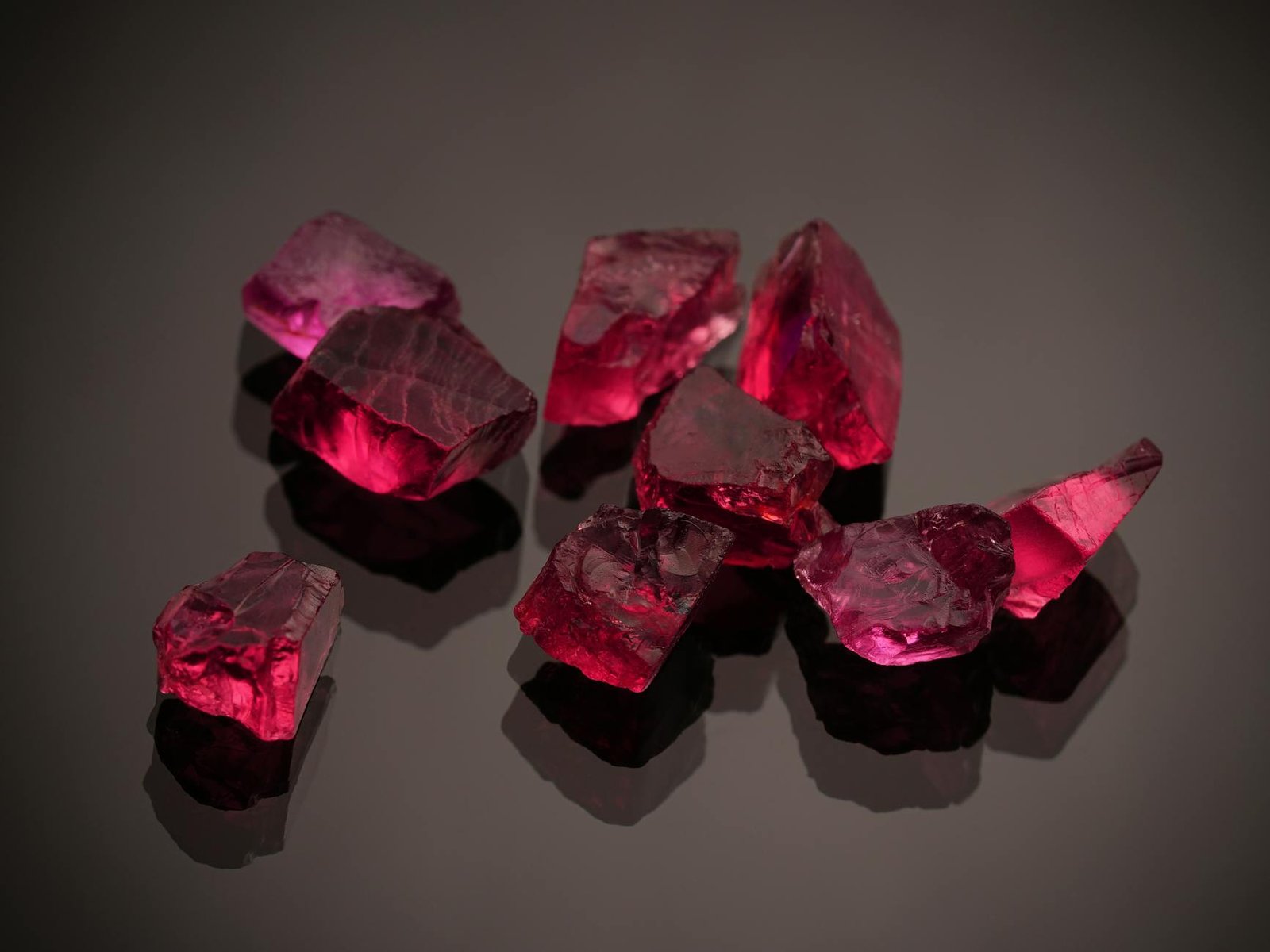
There are gemstones that please the eye, and then there are gemstones that stop the breath entirely. The pigeon blood ruby belongs to the latter category — a stone so deeply saturated, so luminously alive, that the finest examples have commanded auction records measured in millions per carat. It is not merely a colour. It is a phenomenon: a red so pure, so internally lit, that gemologists have reached for the most visceral language they know to describe it, settling finally on the image of a freshly opened vein of a freshly killed pigeon — a term that sounds startling until you see the stone itself, and then suddenly nothing else will do.
The pigeon blood colour is defined by an extraordinary confluence of chromium concentration and iron absence. Chromium ignites the red; the relative scarcity of iron prevents that red from darkening toward brownish tones. The result is a hue that sits at a precise point on the spectrum — vivid, slightly fluorescent under natural light, and utterly without compromise. Among every category of natural gemstone on earth, this particular expression of corundum stands alone in its ability to command both emotional devotion and serious investment capital.
At Yala Gems, we have spent years sourcing, evaluating, and presenting pigeon blood rubies to discerning collectors and couples across Singapore and beyond. What follows is the most comprehensive editorial guide we have written on this singular gemstone — covering its origins, its grading, its investment trajectory, and how to acquire one with absolute confidence.
- Pigeon blood ruby refers to the most prized colour grade in natural ruby — a vivid, fluorescent red with no brown or orange secondary hues, most often originating from Burma (Myanmar) or Mozambique.
- The designation is now formally recognised by major gemological laboratories including GRS and Gübelin, making certified pigeon blood status a critical factor in pigeon blood ruby price determination.
- Unheated pigeon blood rubies command the highest premiums; even a modest carat weight with an unheated certificate can exceed prices of far larger, heat-treated stones.
- Singapore has emerged as Southeast Asia’s premier destination for acquiring certified natural gemstones, offering access to international grading standards, trusted boutiques, and favourable import conditions.
- Whether purchasing a pigeon blood ruby ring for a proposal or adding a loose stone to a serious collection, independent certification and provenance documentation are non-negotiable safeguards.
- The long-tail buyer researching pigeon blood ruby ring price singapore will find that premium stones acquired through reputable local sources offer both transparent pricing and post-purchase support unavailable through anonymous online marketplaces.
The Geography of Red: Where Pigeon Blood Rubies Come From
The Mogok Valley in Upper Myanmar has produced rubies for over a thousand years, and its geological conditions remain unmatched. The metamorphic marble deposits of Mogok create a low-iron environment that allows chromium to express itself without interference — precisely the chemistry that produces pigeon blood colour. When gemologists speak of a “Burmese ruby,” they invoke not just a place but a lineage of excellence that has shaped the entire vocabulary of fine gemstones.
For much of the twentieth century, Mogok was synonymous with the pinnacle of ruby quality. Access was restricted, supply was limited, and stones of true pigeon blood calibre were extraordinarily rare even within this celebrated source. This scarcity built the legend — and the pricing — of Burmese rubies to the heights they occupy today.
The early 2000s introduced a compelling alternative: Mozambique, specifically the Montepuez region, which began producing rubies of exceptional saturation and clarity. Mozambican stones can achieve certified pigeon blood status and in some cases rival their Burmese counterparts at significantly different price points. For the informed buyer, Mozambique represents one of the most exciting developments in ruby sourcing in a generation.
Vietnam, particularly the Luc Yen and Quy Chau regions, contributes rubies of high chromium content as well, though fluorescence characteristics can vary. Sri Lanka, celebrated for its natural sapphire and padparadscha production, occasionally yields rubies, though these tend toward lighter pinkish tones rather than true pigeon blood expression. Origin matters enormously to pricing and collectability, which is why gemological certificates that include country-of-origin determinations are so valuable to serious buyers.
A pigeon blood designation from a laboratory such as GRS (GemResearch Swisslab) or Gübelin Gem Lab is not simply a quality note — it is a standardised colour grade based on spectrophotometric measurement and expert panel review. When a stone receives this designation alongside an “unheated” determination, you are looking at perhaps the single most premium category in the entire natural gemstone market. At auction, such stones have sold for over one million USD per carat. In the context of a pigeon blood ruby ring for a Singapore engagement, even commercially graded stones at two to four carats represent extraordinary lifetime value.
Reading the Stone: How Pigeon Blood Rubies Are Graded
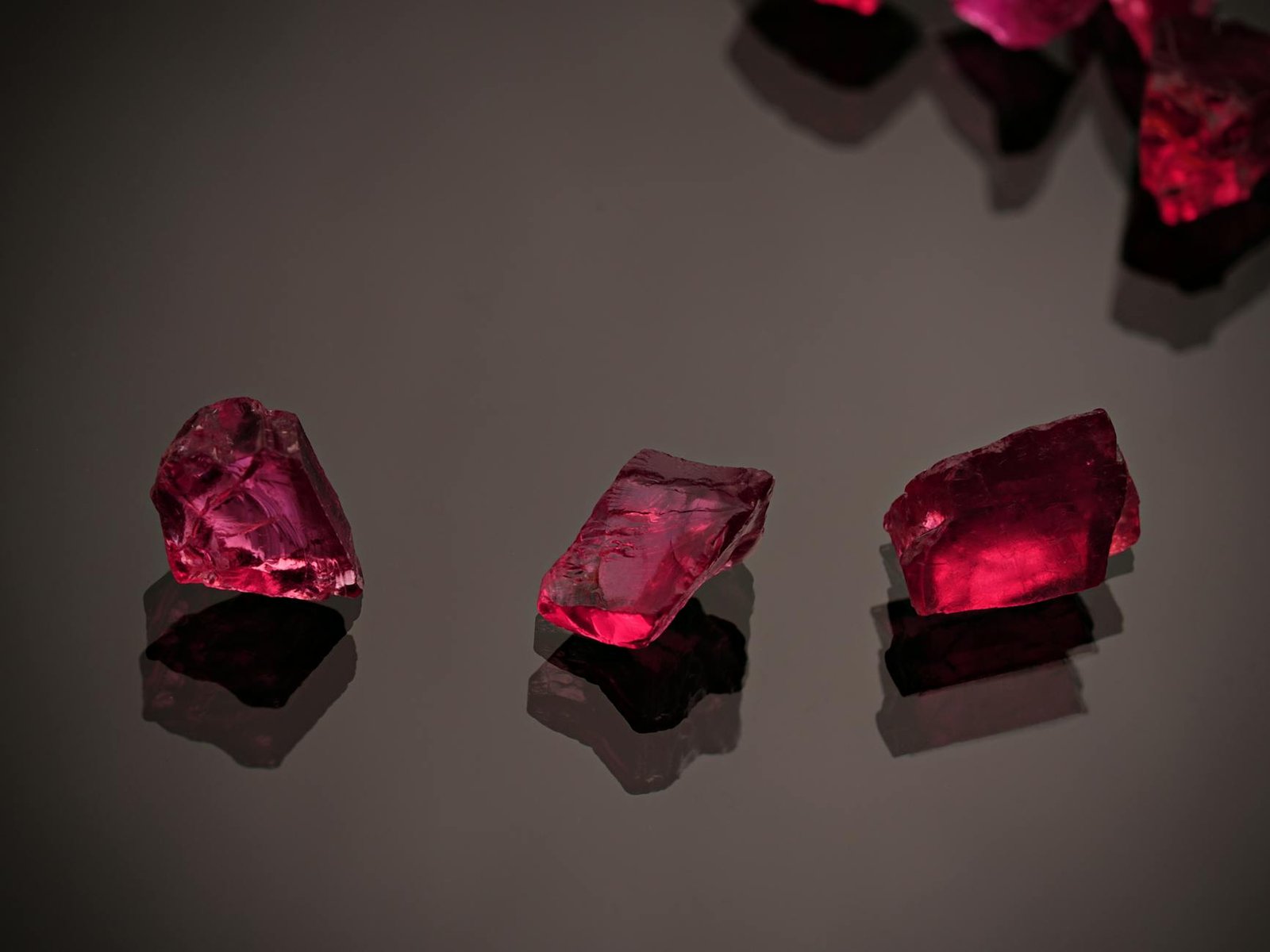
Grading a pigeon blood ruby requires evaluating colour, clarity, cut, and treatment status — but colour reigns supreme in a way it does not in diamonds. The GIA’s standard four Cs framework applies, yet for rubies the hierarchy shifts dramatically in favour of hue, tone, and saturation. A stone of slightly included clarity in perfect pigeon blood colour will vastly outvalue an eye-clean stone of murky, brownish red.
The ideal pigeon blood colour sits at a medium-dark tone — vivid enough to project intensity, but not so dark that the stone loses its luminosity in lower lighting. The saturation must be strong, the hue true red with no discernible secondary colours. Under natural daylight, a genuine pigeon blood ruby exhibits a phenomenon called fluorescence: the chromium atoms re-emit absorbed ultraviolet radiation as additional red light, giving the stone an almost internal glow that synthetic and low-quality rubies simply cannot replicate.
Clarity in rubies follows different conventions than diamonds. Because ruby crystallises in a growth environment rich in mineral inclusions, completely inclusion-free stones are vanishingly rare and, paradoxically, can raise questions of authenticity or treatment. The accepted standard is “eye-clean” — no inclusions visible to the unaided eye at normal viewing distance. Needle-like rutile inclusions, known as silk, are often present in fine naturals and can actually confirm unheated status when examined under magnification.
Treatment disclosure is the most commercially significant grading factor after colour. Heat treatment is the industry norm — the vast majority of commercial rubies are heated to improve colour and clarity. This is accepted practice and properly disclosed. However, unheated natural rubies of pigeon blood quality exist in a category entirely their own, priced at premiums of 200 to 500 percent above comparable heated stones, depending on origin and carat weight. If you are considering acquiring a natural gemstone at this level, insist on a major laboratory certificate that explicitly addresses treatment status.
| Quality Factor | Commercial Grade Ruby | Fine Pigeon Blood Ruby | Unheated Pigeon Blood Ruby |
|---|---|---|---|
| Colour Grade | Medium red, secondary tones present | Vivid red, no secondary hues | Vivid red, certified pigeon blood |
| Treatment | Heat treated (standard) | Heat treated or minor filler | No heat, no treatment |
| Origin | Varied, often undisclosed | Burma, Mozambique, Vietnam | Burma (Mogok) preferred |
| Laboratory Certificate | Optional or absent | GRS, Gübelin, or GIA recommended | GRS or Gübelin with origin report essential |
| Price Per Carat (SGD, approx.) | SGD 500 – 3,000 | SGD 8,000 – 60,000 | SGD 80,000 – 500,000+ |
| Investment Trajectory | Stable to modest growth | Strong historical appreciation | Exceptional long-term appreciation |
A Stone That Holds Its Worth: Collecting and Investment Value
Fine coloured gemstones have attracted serious collector capital for decades, and among them the pigeon blood ruby has consistently outperformed almost every comparable category. The reasons are structural: supply is genuinely finite, no new Mogok equivalent has been discovered, and global demand from collectors in Asia, the Middle East, and Europe grows every decade. Unlike equities or real estate, a certified pigeon blood ruby occupies negligible space, crosses borders with relative ease, and carries its value entirely within itself.
The auction market tells a clear story. Sotheby’s and Christie’s have repeatedly set per-carat records with Burmese pigeon blood rubies, with the Sunrise Ruby — an 25.59 carat Burmese stone — selling for over USD 30 million in 2015. While not every collector operates at that altitude, the directional signal is unmistakable: at every tier of the market, quality pigeon blood material appreciates over time when properly certified and preserved.
“A pigeon blood ruby of fine quality is one of the few objects in the luxury world that simultaneously satisfies the connoisseur’s eye, the romantic’s heart, and the investor’s discipline. It asks nothing of you except the discernment to recognise it.”
For Singapore-based collectors, the calculus is particularly favourable. Singapore imposes no capital gains tax, and the GST treatment of investment-grade gemstones is structured in a way that rewards serious acquisition. Beyond the fiscal environment, the city-state’s connectivity to major auction houses, gem fairs, and international dealers makes it a natural hub for sourcing and liquidating fine stones. Those researching pigeon blood ruby singapore will find that the local market is both sophisticated and well-regulated — a significant advantage over acquiring through less accountable channels.
Collectors should also consider how a pigeon blood ruby sits within a broader portfolio of natural gemstones. Pairing a fine ruby with a Kashmir or Ceylon natural sapphire, for instance, creates a coloured stone collection that covers the two most historically significant blue and red categories simultaneously. Diversification within fine coloured stones is a recognised collector strategy that balances liquidity, aesthetic satisfaction, and long-term value preservation.
One aspect of pigeon blood ruby investment that receives insufficient attention is the role of setting in value preservation. A magnificent stone set in a poorly conceived or low-quality mounting loses none of its intrinsic gem value, but it becomes significantly harder to sell or re-set without incurring costs. When acquiring a pigeon blood ruby ring, commission the setting from a jeweller with demonstrable fine jewellery expertise, and ensure the stone is set in a way that allows future removal without risk of damage. At our Singapore boutique, every bespoke commission is designed with both wearability and long-term gemstone integrity in mind.
Singapore as a Destination for Serious Ruby Buyers
Singapore occupies a unique position in the global luxury gemstone market. Its geographic proximity to the ruby-producing regions of Southeast and South Asia, combined with its status as a world-class financial and luxury hub, makes it genuinely exceptional for buyers seeking certified pigeon blood material. The concentration of established jewellers, visiting international gem dealers, and access to top-tier gemological laboratory services is matched in Asia only by Hong Kong — and Singapore offers a regulatory environment that many buyers find considerably more transparent.
The question of where to buy a pigeon blood ruby in Singapore is not simply about geography. It is about access to expertise, the ability to view stones in person under controlled lighting conditions, the assurance of accurate treatment disclosure, and the availability of after-sale services including re-certification, re-setting, and insurance valuation. These are services that anonymous online platforms cannot replicate, regardless of how professionally their listings are photographed.
For those who prefer to buy gemstone online, Singapore-based boutiques with a physical presence offer the ideal hybrid: the convenience of digital browsing and inquiry combined with the security of being able to visit, inspect, and speak with our gemologists in person before any commitment is made. This model is particularly valuable for high-value purchases where the difference between a genuine pigeon blood ruby and a well-photographed, over-graded stone can represent tens of thousands of dollars.
Buyers researching pigeon blood ruby singapore price will also benefit from understanding the local premium structure. Singapore-based fine jewellers source from international markets and apply transparent margins that reflect their curation, certification support, and after-sale care. This differs meaningfully from grey market pricing, which may appear lower but typically lacks certification, provenance documentation, or any recourse in the event of misrepresentation.
How to Buy a Pigeon Blood Ruby with Confidence
Acquiring a pigeon blood ruby — whether as a loose stone or set within a gemstone ring — is a significant decision that rewards preparation. The first principle is certification: any stone represented as pigeon blood quality should be accompanied by a report from GRS, Gübelin, GIA, or another internationally recognised laboratory. The report should include a colour grade, treatment disclosure, and ideally a country-of-origin determination. Without this documentation, the designation “pigeon blood” is nothing more than a marketing claim.
The second principle is provenance transparency. Ask your seller directly: where did this stone come from, and can that origin be traced? Responsible sourcing matters both ethically and commercially. Burmese ruby sourcing carries ongoing due diligence considerations given export restrictions in various markets; reputable sellers will be conversant with these questions and prepared to address them honestly.
Third, understand the return and dispute resolution policy before purchasing. When you buy gemstone online or through a boutique, you should have the right to seek an independent second opinion from a gemologist of your choosing within a defined window. Any seller who resists this provision should be approached with significant caution.
Fourth, consider the setting context carefully. A pigeon blood engagement ring singapore purchase is not merely a gemstone acquisition — it is also a jewellery design commission. Ensure your jeweller has experience with high-value ruby setting, understands the specific structural requirements of corundum (harder than almost any other gem, but still susceptible to inclusions propagating under impact), and can produce certification-level documentation of the metal and its composition.
Finally, cultivate a relationship with your gemologist. The gemstone market rewards relationships built on trust and expertise. A jeweller who knows your collection, your preferences, and your investment criteria will present opportunities that never appear on any public listing. At Yala Gems, this kind of ongoing client relationship is the foundation of everything we do — connecting discerning buyers with natural gemstone material that genuinely merits their attention.
Frequently Asked Questions
Final Thoughts
The pigeon blood ruby is not simply the finest variety of a precious gemstone — it is one of the most concentrated expressions of natural rarity that the mineral kingdom has produced. The precise geological conditions required to generate its colour, the centuries of trade history that have defined its significance, and the modern gemological rigour now applied to its certification all conspire to make it genuinely irreplaceable. No synthetic, no simulant, and no other stone occupies the same position in the hierarchy of precious materials.
For buyers in Singapore and across the region, the opportunity to acquire a certified pigeon blood ruby — whether as a loose collector’s stone, a centrepiece for a bespoke gemstone ring, or the heart of a pigeon blood engagement ring — has never been better supported by accessible expertise and transparent market infrastructure. The key is to approach the acquisition with the same seriousness the stone itself demands: prioritise certification, understand provenance, and work with gemologists whose knowledge runs as deep as their commitment to honesty.
Whether you are taking your first steps into fine coloured stones or adding a crown jewel to a mature collection, a pigeon blood ruby rewards every degree of care you bring to its selection. It will outlast trends, outlast markets, and outlast the occasion for which it was originally chosen — which is, in the end, exactly what a truly great natural gemstone should do.
Ready to Find Your Pigeon Blood Ruby?
Our gemologists are available to guide you through every step — from understanding certification to selecting the perfect setting for your vision. Visit our Singapore boutique or begin your journey through our knowledge resources.