
Not every gemstone appreciates. The market is exacting, and the distance between a stone that doubles in value over a decade and one that stagnates in a drawer often comes down to a handful of precise characteristics — origin, treatment status, certification, and colour saturation measured in fractions of a grade. For serious buyers evaluating best gemstones for investment, the conversation has to move past category names and into the granular evidence: which specific varieties have posted consistent price appreciation, what drives those gains, and exactly what buying criteria determine whether a stone qualifies as a genuine store of wealth.
This article focuses precisely on that question. We examine five gemstone types — ruby, blue sapphire, emerald, alexandrite, and Paraiba tourmaline — with reference to documented auction results, wholesale price trends, and the certification benchmarks that institutional buyers and serious collectors consistently apply. If you are exploring gemstone investment in Singapore or building a portfolio of tangible alternative assets, the data and criteria below will give you a sharper framework than almost any generalised overview can provide.
- unheated Burmese rubies with GRS or Gübelin “pigeon blood” designations have achieved price-per-carat increases exceeding 300% at major auctions over the past fifteen years.
- Kashmir and unheated Ceylon sapphires command a significant premium over heated stones of identical appearance — often 200–400% more per carat at comparable quality.
- alexandrite’s extreme rarity and genuine colour-change phenomenon make supply contraction structural, supporting long-term price floors that few other natural gemstones can match.
- Brazilian Paraiba tourmaline under one carat with strong neon saturation has seen consistent price appreciation, with per-carat values for top specimens surpassing those of many diamonds.
- Across all five categories, a natural gemstone with a credible origin report, no treatment or minor treatment only, and a weight above the key threshold for its species is the baseline investment-grade criterion.
Ruby: The Gemstone With the Strongest Auction Record
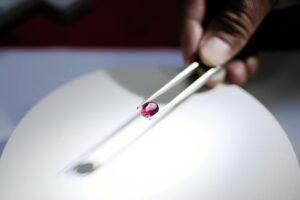
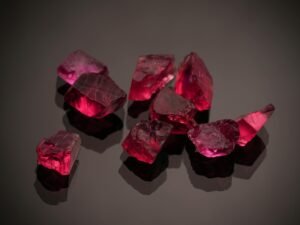
Among all coloured stones, no natural gemstone has produced more headline auction results than the ruby. The 2015 Christie’s sale of the Sunrise Ruby — 25.59 carats, unheated Burmese, Gübelin certified — achieved USD 30.3 million, or roughly USD 1.18 million per carat. That single result crystallised what specialist buyers had understood for decades: at the apex of quality, rubies are categorically scarce in a way that very few assets are.
Price appreciation data from the past two decades is consistent. Top-grade Burmese rubies in the 2–5 carat range saw per-carat wholesale values rise from approximately USD 15,000–25,000 in the early 2000s to USD 60,000–150,000 by the early 2020s at equivalent quality benchmarks. Heated stones from the same origin appreciated too, but at a fraction of that rate. The treatment gap is not cosmetic — it is the single most important value variable in ruby investment.
For buyers evaluating rubies as an investment, the criteria are non-negotiable. First, insist on a laboratory report from GRS, Gübelin, or SSEF that specifies Burmese origin and confirms no heat treatment or minor heat evidence only. Second, prioritise stones above 1 carat — the per-carat premium accelerates sharply above this threshold. Third, colour grading should reach “vivid red” or “pigeon blood” designation. A stone that lacks origin documentation loses a substantial portion of its resale premium, regardless of appearance.
Sapphire: Why Origin Commands Everything

Blue sapphire is the most liquid of the investment-grade coloured stones, partly because the category is broad enough to include multiple price tiers. But within that breadth, the investment case concentrates sharply in two origin categories: Kashmir and unheated Ceylon (Sri Lanka). Understanding why requires a brief look at what the market actually prices.
Kashmir sapphires — mined from a remote Himalayan deposit that has produced no meaningful commercial output since the 1880s — are effectively a fixed supply asset. A Kashmir origin report from a major laboratory can increase a stone’s value by 300–600% over a comparable-quality heated Thai or Madagascar sapphire. Prices for fine Kashmir specimens have escalated from roughly USD 50,000 per carat in 2005 to over USD 200,000 per carat for exceptional pieces at recent Sotheby’s and Christie’s sales. That is a trajectory very few alternative investments can replicate.
unheated Ceylon sapphires occupy the next tier and represent a more accessible entry point for buyers building a gemstone investment portfolio. Sri Lanka continues to produce fine material, but unheated stones of strong cornflower blue at 3 carats and above are genuinely uncommon. Per-carat premiums for unheated versus heated Ceylon sapphires have widened steadily, running at 200–400% depending on colour saturation and clarity. When you buy gemstone online or through a specialist boutique, this treatment distinction must appear explicitly on the accompanying laboratory certificate — not inferred from the stone’s appearance.
One factor that many first-time buyers underestimate is the weight threshold effect. In sapphire, the per-carat value curve inflects meaningfully at 3 carats and again at 5 carats for unheated material. A 4.80-carat stone and a 5.10-carat stone of identical quality can carry a 20–30% per-carat price difference purely because of that threshold crossing. When building an investment position, buying stones that sit comfortably above — rather than just at — these thresholds offers a meaningful margin of safety on resale.
Emerald, Alexandrite, and Paraiba: The Specialist Tier
Beyond ruby and sapphire, three gemstone types have demonstrated exceptional investment characteristics for buyers willing to operate in a more specialised market. Each rewards specific knowledge, and each carries distinct buying criteria that diverge from the broader precious stone market.
Colombian Emerald — Colombia remains the benchmark origin for investment-grade emeralds in a way that Myanmar defines rubies. Muzo and Coscuez production carries the highest premiums, and the investment case for emerald is partly a story about acceptable inclusions. Unlike rubies and sapphires, emeralds almost universally contain jardin — the characteristic internal fissure network — and the market accepts minor to moderate clarity characteristics provided the colour is exceptional. What it does not accept is significant clarity enhancement. Cedar oil or resin filling rated “none” or “minor” by the GRS or AGL laboratory standard is the line. Heavily oiled stones trade at steep discounts and face persistent resale resistance. Fine Colombian emeralds in the 2–5 carat range have appreciated from approximately USD 8,000–12,000 per carat in 2005 to USD 30,000–80,000 for top colour and minor enhancement today.
Alexandrite — The investment argument for alexandrite is structural scarcity. The original Ural Mountain source in Russia is essentially exhausted. Brazilian and Sri Lankan material exists, but fine colour-change stones — those shifting from a saturated green in daylight to a strong raspberry or purplish-red under incandescent light — are extraordinarily rare above 2 carats. Per-carat prices for Russian alexandrite with strong colour change have reached USD 60,000–150,000 at the 2-carat-plus level. Supply cannot be meaningfully increased, which creates a price floor that few other gemstone categories enjoy. Buyers should require a GRS or Gübelin report confirming chrysoberyl species, origin, and the degree of colour change described in percentage terms.
Paraiba Tourmaline — Discovered in Brazil’s Paraíba state in the late 1980s, these copper-bearing tourmalines occupy a unique price position. Their neon blue-green saturation is unlike anything else in the mineral world, and the original Brazilian deposit is largely exhausted. While Mozambican and Nigerian material bearing the Paraiba designation exists, the market applies a significant premium to Brazilian origin. Top Brazilian Paraiba with vivid neon saturation below 1 carat has traded at USD 20,000–50,000 per carat; exceptional pieces above 3 carats have achieved over USD 100,000 per carat. The buying criterion here is copper and manganese content verified by a major laboratory, combined with a Brazilian origin report. Saturation matters more than hue shift — the neon quality, not merely the colour family, is what the market prices.
“The gemstones that appreciate most reliably are not simply the prettiest — they are the ones where the combination of geological rarity, treatment integrity, and credible certification creates a price floor the market consistently defends.”
Buying Criteria Across the Five Categories

For anyone building a portfolio approach to precious stones investment, it helps to see the critical variables mapped side by side. The table below distills the key investment-grade criteria for each of the five gemstone types covered in this article. These are the benchmarks that auction houses, institutional buyers, and specialist dealers apply when assessing whether a stone qualifies as investment-grade rather than simply fine jewellery quality.
| Gemstone | Benchmark Origin | Treatment Standard | Minimum Weight (Investment) | Key Laboratory | Approx. Top Per-Carat Range (2023) |
|---|---|---|---|---|---|
| Ruby | Burma (Mogok) | No heat / minor heat | 1 carat | GRS, Gübelin, SSEF | USD 60,000 – 200,000+ |
| Blue Sapphire | Kashmir; Ceylon (unheated) | No heat | 3 carats | GRS, Gübelin, SSEF | USD 50,000 – 200,000+ |
| Emerald | Colombia (Muzo, Coscuez) | None / minor clarity enhancement | 2 carats | GRS, AGL, Gübelin | USD 30,000 – 100,000+ |
| Alexandrite | Russia (Ural); Brazil | No treatment | 1 carat | GRS, Gübelin | USD 60,000 – 150,000+ |
| Paraiba Tourmaline | Brazil (Paraíba state) | Heated acceptable | 0.5 carats | GRS, Gübelin, SSEF | USD 20,000 – 100,000+ |
Singapore buyers have a particular structural advantage in this market. As a major hub for coloured stone trading in Southeast Asia, the city-state provides access to stones in transit from Sri Lanka, Myanmar, and Brazil before they reach Western auction circuits. Buying through a reputable gemstone investment boutique Singapore with established supplier relationships — rather than through secondary market platforms — means encountering investment-grade material at earlier points in the price chain. At Yala Gems, our sourcing relationships are built specifically around certified, origin-verified natural gemstones that meet the investment criteria outlined in this article. If you are ready to evaluate specific stones, speak with our gemologists directly for a curated selection.
Is Buying Gemstones a Good Investment? An Honest Assessment
The honest answer is: yes, under specific conditions, and no, as a general statement. The coloured stone market is not liquid in the way that equities are. There is no exchange, no daily price feed, and resale requires access to the right buyers — typically auction houses, specialist dealers, or collectors who understand origin premiums. A buyer who purchases an investment-grade ruby today and needs to liquidate in eighteen months may find the process slower and the realisable price narrower than expected.
That said, for buyers with a 5–15 year horizon, the record across the five categories in this article is genuinely compelling. Gemstones that hold value — and the ones that appreciate — share a common profile: natural origin, conservative or no treatment, top-tier certification, and weight above the key market thresholds. Stones meeting all four criteria in the right origin categories have outperformed many conventional asset classes over multi-decade periods.
The key risk factors are counterparty quality, certification fraud, and overpaying for commercial-grade material presented as investment-grade. This is why acquiring loose gemstones for investment in Singapore through a vetted specialist — rather than through unverified online sellers — is not merely a preference but a risk management decision. Our broader Timeless Investment pillar covers the full framework for building a gemstone portfolio, including liquidity strategies, insurance, and estate planning considerations that extend well beyond individual stone selection.
For Singapore-based buyers specifically, the combination of zero capital gains tax on asset appreciation, strong legal infrastructure for ownership documentation, and proximity to Asian coloured stone supply chains makes alternative investments in gemstones in Singapore a structurally attractive proposition relative to many other global markets.
Frequently Asked Questions
Final Thoughts
The five gemstone categories examined here — ruby, sapphire, emerald, alexandrite, and Paraiba tourmaline — are not equally accessible, equally liquid, or equally certain in their appreciation trajectories. What they share is a common foundation: geological rarity that is structural rather than cyclical, a certification infrastructure that allows buyers to verify what they own, and a global collector base that consistently defends price floors for the finest material.
The best gems to buy for investment are always the ones where documentation, origin, treatment status, and weight all align with investment-grade criteria simultaneously. A stone that excels on three of those four dimensions is fine jewellery. A stone that satisfies all four is a genuine alternative asset. For a broader view of how gemstones fit within a diversified portfolio — covering liquidity planning, insurance, and estate considerations — our Timeless Investment pillar article provides the comprehensive framework that this focused analysis deliberately complements rather than replaces.
If you are ready to move from research to evaluation, the team at Yala Gems maintains curated access to certified, origin-verified stones across all five categories. We work with buyers at every stage of the acquisition process, from first-time investors establishing parameters to experienced collectors seeking specific specimens.
Ready to Build a Gemstone Portfolio?
Explore our full knowledge library on gemstone investment, buying criteria, and market intelligence — or speak with our team directly to begin your acquisition journey.