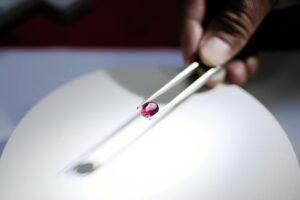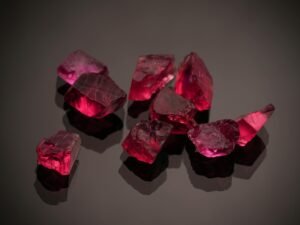

There are gemstones that are beautiful, and then there are gemstones that stop a room. The pigeon blood ruby belongs unambiguously to the second category. Its colour — a saturated, internally luminous red with the faintest blue undertone — has no true equivalent in the natural world, which is precisely why connoisseurs, collectors, and lovers have pursued it across centuries and continents. To hold a genuine pigeon blood ruby under daylight is to understand, instantly and viscerally, why certain stones acquire the gravity of legend.
The term “pigeon blood” is not mere poetry. It is a grading designation recognised by the world’s foremost gemological laboratories — GIA, Gübelin, and SSEF among them — applied only to natural rubies that meet an extraordinarily narrow set of colour criteria. The saturation must be vivid but never dark, the hue must sit precisely at pure red, and the fluorescence under UV light must amplify rather than muddy the stone’s appearance. Fewer than one in several thousand ruby crystals extracted from the earth will ever merit the classification. That scarcity is the foundation of everything: the desire, the price, and the prestige.
At Yala Gems, we have spent years cultivating direct relationships with trusted sources across Myanmar, Mozambique, and beyond, so that Singapore collectors have access to certified pigeon blood rubies of genuine provenance. This guide exists to educate you fully — on colour, quality, value, and the art of buying wisely — so that when you encounter the right stone, you are ready to recognise it.
- Pigeon blood ruby is a formal colour grade, not a marketing label — it is awarded by leading gemological laboratories to natural rubies of exceptional hue, saturation, and fluorescence.
- Burmese origin, particularly from Mogok, remains the most prized provenance, though fine pigeon blood stones now emerge from Mozambique and a handful of other localities.
- Pigeon blood ruby price scales dramatically with carat weight — a certified 2-carat stone can command multiples of the per-carat price achieved by a 1-carat equivalent.
- Laboratory certification from GIA, Gübelin, or SSEF is non-negotiable for any serious purchase; it confirms both the colour grade and the absence of treatment beyond acceptable heat enhancement.
- Singapore has emerged as one of Asia’s most trusted destinations for acquiring certified natural gemstones, with strong consumer protections and a concentration of reputable specialist jewellers.
- Whether you buy in boutique or choose to buy gemstone online, insisting on full documentation and a clear returns policy protects your investment at every price point.
The Sacred Origins of Pigeon Blood Colour
Ask any seasoned gem trader where pigeon blood rubies come from and the answer will begin, invariably, with one word: Mogok. This remote valley in upper Myanmar has produced rubies for over a thousand years, and its geological conditions — a rare convergence of marble host rock, tectonic pressure, and the near-total absence of iron — create the conditions for corundum crystals of unmatched chromium concentration. It is chromium that produces red in ruby, and it is chromium at very high levels that produces the specific, almost incandescent red we call pigeon blood.
The name itself originates from Burmese gem culture. Traders historically described the finest rubies as resembling the first two drops of blood from the eye of a freshly sacrificed pigeon — a vivid, saturated crimson with a slight blue cast, never dark, never orange, never pink. Modern gemology has codified this description into measurable spectroscopic parameters, but the poetic origin remains apt. No other colour description in gemmology carries quite the same weight of cultural history.
Beyond Myanmar, Mozambique — specifically the Montepuez region, discovered commercially around 2009 — now yields natural rubies that regularly achieve pigeon blood certification. Mozambican stones tend toward slightly higher iron content, which can suppress fluorescence, but exceptional specimens rival their Burmese counterparts in every measurable criterion. Origin still commands a premium at auction, but a certified Mozambican pigeon blood ruby of superior colour is objectively more valuable than an inferior Burmese stone — a nuance that educated buyers at our Singapore boutique understand well.
Chromium is the chromophore responsible for ruby’s red, but it also causes strong red fluorescence under UV light. In pigeon blood rubies, this fluorescence activates even under ordinary daylight, which contains UV components — making the stone appear to glow from within. This self-luminosity is one of the most reliable visual indicators of genuine pigeon blood colour and cannot be replicated by synthetic or treated stones to the same degree. When evaluating a ruby in natural light, a stone that seems to pulse with inner fire is exhibiting precisely this phenomenon.
How Pigeon Blood Ruby Colour and Quality Are Evaluated

Understanding what colour is pigeon blood ruby — and how it is formally assessed — is the single most important piece of knowledge a buyer can possess. The grade is assigned when a natural ruby’s primary hue is red (not orangey-red, not purplish-red, but red), its tone sits in the medium to medium-dark range without crossing into darkness, and its saturation is vivid. Beyond hue alone, the stone must exhibit strong chromium fluorescence and what gemmologists describe as a “silk” — microscopic rutile needle inclusions that scatter light internally and soften any harshness in colour distribution.
Clarity in pigeon blood rubies is assessed differently from diamonds. Eye-clean stones of this grade are extraordinarily rare; the trade accepts certain inclusions — needle silk, fingerprints, growth zoning — as part of the natural gem’s character. What matters is that no inclusion reaches the surface in a way that threatens durability, and that no fracture-filling or glass treatment has been used to mask clarity. Beryllium diffusion and lead-glass filling are the two treatments that most significantly diminish value, and both are detectable only through laboratory analysis.
Cut quality shapes how the stone’s colour is perceived. A well-proportioned oval or cushion cut will return the maximum amount of red light to the eye; a cut that is too deep will create a dark centre, while a shallow cut will allow light to escape without interaction. The finest pigeon blood rubies are cut in Burma or Thailand by craftsmen who have spent lifetimes understanding how to manipulate corundum’s optical properties. When you speak with our gemologists, cut quality is always part of the conversation — it is as consequential as colour grade for the stone’s final beauty.
| Quality Factor | Pigeon Blood Standard | Commercial Ruby Standard | Impact on Price |
|---|---|---|---|
| Primary Hue | Pure red (R) | Orangey-red to purplish-red | Hue alone can double or halve value |
| Saturation | Vivid (vS6–vS7 on GIA scale) | Strong to moderately strong | Vivid saturation commands 3–5× premium |
| Fluorescence | Strong red UV fluorescence | Moderate to weak | Strong fluorescence adds 15–30% in top grades |
| Treatment | No treatment or minor heat only | Heat, beryllium, glass-filling accepted | Unheated stones carry 30–100% premium |
| Certification | GIA / Gübelin / SSEF mandatory | Optional at lower price points | Certification adds liquidity and resale trust |
| Origin | Mogok preferred; Mozambique accepted | Thailand, Tanzania, other origins | Mogok origin adds 20–50% over comparable stones |
Collector Appeal and Investment Value
Among natural gemstones, pigeon blood rubies have demonstrated one of the most consistent records of value appreciation over the past three decades. Major auction houses — Sotheby’s, Christie’s, and Bonhams — regularly set price-per-carat records with these stones. In 2015, the Sunrise Ruby, a Burmese pigeon blood stone of 25.59 carats, sold for over USD 30 million, establishing a world record for any ruby and for any coloured gemstone at auction at the time. Such events are not anomalies; they reflect a structural imbalance between finite supply and accelerating global demand from collectors across Asia, the Middle East, and Europe.
Pigeon blood ruby price is heavily nonlinear with carat weight. A 1-carat certified stone might trade between USD 10,000 and USD 30,000 per carat depending on quality. A comparable 3-carat stone will not simply be three times the price — the per-carat value may be two to four times higher again, because large, fine stones are exponentially rarer than small ones. This price structure rewards patience and the willingness to invest meaningfully in a single exceptional specimen rather than accumulating many modest ones.
For collectors interested in wearable investment pieces, a pigeon blood ruby ring set in platinum or high-karat gold represents one of the most defensible luxury purchases available. The stone retains its value independent of the setting’s metal content, and its portability, durability (corundum scores 9 on the Mohs scale), and universal recognition make it a genuinely liquid asset in the way that many alternative investments are not. Clients who speak with our gemologists about pigeon blood engagement ring options often discover that the stone they purchase today is appreciably more valuable within five years.
“A fine pigeon blood ruby does not merely reflect light — it generates it. That inner luminosity, that sense that the stone is alive with colour rather than simply coloured, is what separates a great ruby from every other red gemstone in existence.”
Singapore as a Premier Destination for Natural Rubies

Singapore’s position as a global financial and trading hub has made it, quietly and deliberately, one of Asia’s most important centres for certified natural gemstones. The city-state’s strict import and consumer protection regulations, its concentration of internationally trained gemologists, and its access to supply chains across Southeast Asia, Sri Lanka, and East Africa create conditions that few other markets can replicate. For the discerning buyer, purchasing a pigeon blood ruby in Singapore carries a level of legal and professional accountability that many other markets — including certain famous gem-trading cities — cannot guarantee.
The Singapore gemstone market has also matured significantly in sophistication. A decade ago, a buyer seeking pigeon blood ruby in Singapore might have struggled to find certified stones with full laboratory documentation. Today, specialist jewellers like Yala Gems maintain curated inventories of GIA- and Gübelin-certified rubies, with transparent pricing and provenance documentation that meets the standards expected by international collectors. This professionalism reflects the broader evolution of Singapore as a wealth management centre — clients expect the same rigour from their gemstone purchases as from any other alternative asset class.
For international buyers, Singapore also offers practical advantages: a stable currency, efficient international shipping infrastructure, and a duty structure that makes the city genuinely competitive for high-value gemstone transactions. Whether you are a local collector or a visitor exploring the city’s jewellery district, the combination of selection, certification standards, and professional counsel available here is exceptional. Those seeking to buy gemstone online from Singapore-based specialists benefit from the same accountability — reputable boutiques provide full documentation, insured shipping, and the ability to verify any stone with an independent appraiser upon receipt.
Singapore buyers should be aware that “pigeon blood” is not a legally protected term in most jurisdictions — which means it can be, and sometimes is, used loosely by sellers who have not obtained formal laboratory certification. The only reliable protection is a report from GIA, Gübelin, or SSEF that explicitly uses the phrase “pigeon blood” in the colour description field. At our Singapore boutique, every ruby we describe as pigeon blood grade is accompanied by one of these three reports. If a seller cannot produce laboratory documentation, walk away regardless of how compelling the stone appears in isolation.
How to Buy a Pigeon Blood Ruby Safely — Online and In Person
The decision to buy gemstone online requires a higher level of due diligence than an in-person transaction, but it is entirely viable when approached correctly. The internet has genuinely expanded access to exceptional stones — buyers in Singapore can now view pigeon blood rubies sourced directly from Mogok through specialist platforms without the traditional markups of multiple intermediaries. The risk lies not in the medium but in the absence of verification, which is why documentation and seller accountability must be non-negotiable.
When purchasing online, request the full laboratory report number and verify it directly on the issuing laboratory’s website before any payment is made. Reputable laboratories — GIA, Gübelin, SSEF — all operate online verification portals. Confirm that the report describes the stone as a natural ruby, specifies the colour as pigeon blood or equivalent, and notes the treatment status clearly. For pigeon blood ruby ring purchases specifically, also request images of the stone loose (unmounted) if possible, or at minimum a detailed video in natural daylight and under a UV lamp.
In-person purchasing at an established boutique allows for direct examination under multiple light sources, but the same documentation standards apply. Do not allow a charming stone or a persuasive presentation to substitute for paperwork. Additionally, understand the seller’s return and exchange policy before completing a purchase — reputable jewellers stand fully behind the accuracy of their representations. A pigeon blood ruby ring for sale at a credible establishment will always come with documentation, a receipt that describes the stone accurately, and a clear path to independent appraisal. Anything less is a red flag, regardless of the price point.
For gemstone ring settings, consider the metal and construction carefully. Pigeon blood rubies are best protected in platinum or 18-karat gold prong or bezel settings that secure the stone without obscuring its colour. The setting should be crafted to allow maximum light entry from below. If you are commissioning a bespoke pigeon blood ruby ring, work with a jeweller who has experience with high-value corundum — the cutting and setting of a significant ruby demands a level of craft that not every workshop possesses.
Frequently Asked Questions
Final Thoughts
A pigeon blood ruby is not an impulse acquisition. It demands patience, education, and a willingness to wait for the right stone rather than settling for an approximation. But for those who approach it seriously, the reward is singular: ownership of one of nature’s most extraordinary creations, a natural gemstone of documented rarity whose beauty has fascinated humanity for millennia and whose value has only strengthened with time.
The practical path forward is straightforward. Educate yourself on colour, certification, and provenance — this guide is a beginning, not an endpoint. Insist on laboratory documentation from GIA, Gübelin, or SSEF. Work with a jeweller who speaks the language of gemology fluently and who will stand behind every claim in writing. And when the right stone appears — when you hold it in natural light and see that inner crimson luminosity that no photograph can fully capture — trust your instincts. The finest pigeon blood rubies announce themselves.
Singapore is one of the finest places on earth to begin that search, and Yala Gems exists to make the journey as informed, transparent, and rewarding as the destination itself.
Ready to Find Your Pigeon Blood Ruby?
Explore our curated knowledge hub and deepen your understanding of the world’s most coveted natural gemstones — then speak with our specialists when you are ready to take the next step.