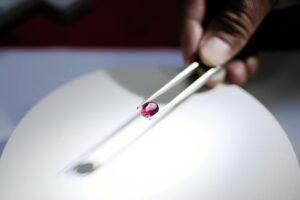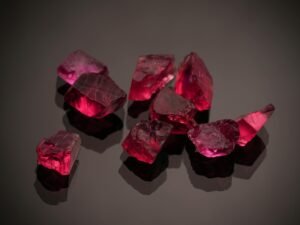
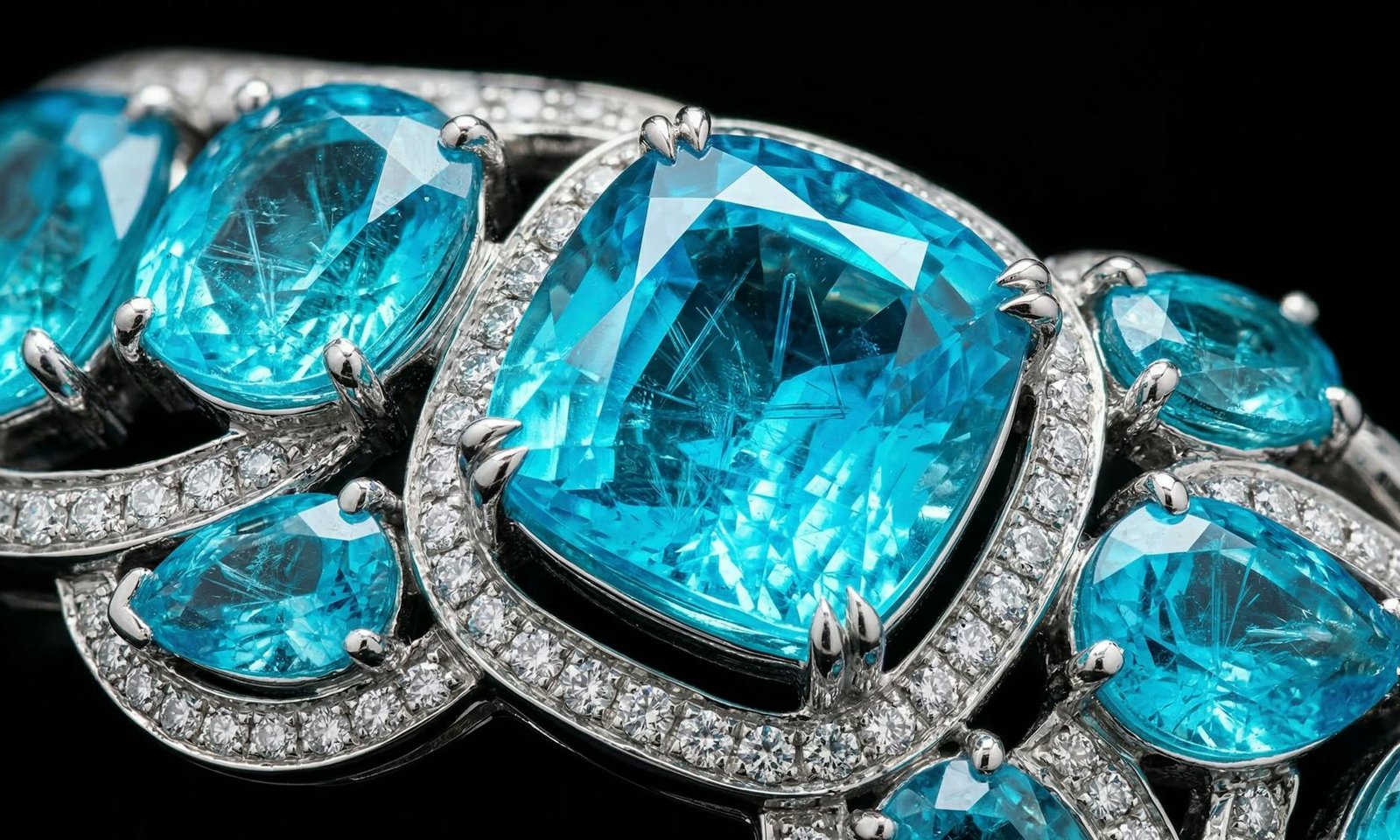
There are gemstones that are simply beautiful, and then there are gemstones that stop a room. Paraiba tourmaline belongs unmistakably to the second category. With an electric neon luminescence that reads as almost supernatural — vivid cyan, swimming-pool blue, and incandescent green all fused into a single stone — the paraiba tourmaline occupies a tier of desirability that very few natural gemstones ever reach. To hold one beneath the light is to understand, immediately and viscerally, why collectors and connoisseurs pursue them with such intensity.
What separates paraiba tourmaline from every other coloured stone is not merely its colour, though the colour alone would be enough. It is the mechanism behind that colour — copper and manganese locked inside the crystal lattice at the point of formation — that produces the stone’s signature glow. Most gems reflect light. Paraiba appears to generate it from within, a quality gemologists describe as neon fluorescence and collectors describe, more simply, as magic. No other tourmaline, and very few natural gemstones of any variety, share this trait.
At Yala Gems, our Singapore boutique has spent years curating the finest examples of this extraordinary stone for discerning buyers across Southeast Asia and beyond. Whether you are drawn to a paraiba tourmaline ring as a statement of personal elegance, a loose paraiba tourmaline stone for a bespoke commission, or a paraiba tourmaline necklace as a centrepiece acquisition, understanding the gem deeply is the first step toward choosing wisely. This guide covers everything — from the mines of Brazil to the pricing benchmarks that matter today.
- Paraiba tourmaline derives its extraordinary neon glow from trace copper content — a geological rarity found in fewer than three mining regions worldwide.
- Paraiba tourmaline price per carat ranges from approximately USD 3,000 to over USD 50,000, depending on origin, saturation, clarity, and carat weight.
- Brazilian material from the original Batalha mine commands the highest premiums; Mozambican stones offer comparable colour at relatively accessible price points.
- On the Mohs hardness scale, paraiba tourmaline registers 7 to 7.5 — suitable for jewellery with proper setting design and mindful daily care.
- Certified, untreated specimens have demonstrated consistent value appreciation, making them a compelling option for the serious gemstone collector.
- Singapore is emerging as one of Asia’s foremost destinations for acquiring authenticated paraiba tourmaline, with dedicated boutiques offering transparency, provenance documentation, and expert guidance.
The Story Beneath the Earth: Origin and Provenance
The paraiba tourmaline’s story begins in the late 1980s, in the Brazilian state of Paraíba — the gem’s namesake and spiritual home. A prospector named Heitor Dimas Barbosa spent the better part of a decade convinced that something extraordinary lay within those hillsides. In 1989, he was proven spectacularly right. The stones that emerged from the Batalha mine were unlike anything the gemological world had encountered: tourmalines with a copper-saturated colour so intense that even small, heavily included specimens commanded attention reserved for flawless diamonds.
The original Brazilian deposits — specifically those in the municipalities of São José da Batalha and Mulungu — remain the benchmark for the category. Paraiba tourmaline brazil material is distinguished not only by its colour range but by the concentration of copper that drives saturation to almost electric levels. Supply from these mines is now extraordinarily limited, as the primary deposits are essentially exhausted, and new finds are measured in individual crystals rather than parcels. This geological scarcity is the foundational reason why paraiba tourmaline is so expensive, and why that price shows no structural reason to decline.
In the early 2000s, similar copper-bearing tourmalines were discovered in Nigeria and then in Mozambique. The Mozambican material in particular has achieved wide recognition, offering the signature neon blue-green palette in stones that are often cleaner and larger than their Brazilian counterparts. The trade and major gemological laboratories — GIA and Gübelin among them — now certify all three origins under the paraiba designation, provided copper is confirmed as a chromophore. That said, the origin premium for Brazilian material remains significant, sometimes doubling or tripling the per-carat value over comparable Mozambican stones.
When evaluating a paraiba tourmaline stone, always request a country-of-origin certificate from a recognised laboratory such as GIA, Gübelin, or SSEF. Brazilian origin can add 100–300% in premium over Mozambican material of identical colour quality. Our gemologists at Yala Gems source stones with full documentation precisely because origin transparency is non-negotiable for serious collectors.
Reading the Stone: Quality Evaluation and the Four Cs

Evaluating a paraiba tourmaline requires a slightly different framework than standard diamond grading, because colour — specifically the hue, saturation, and that copper-induced neon quality — dominates value above all other factors. The most prized hues fall within the vivid blue to blue-green spectrum, with what the trade calls “neon” or “electric” saturation. Stones that lean too heavily toward green, or that display grey modifiers dulling the tone, sit considerably lower in the pricing hierarchy.
Clarity expectations for paraiba tourmaline are calibrated against the category’s natural growth characteristics. Unlike diamonds or sapphires, these stones frequently form with characteristic inclusions — needle-like growth channels called “swimming inclusions” are considered acceptable and sometimes even charming by connoisseurs. Eye-clean stones do exist and attract significant premiums. However, a heavily included specimen with extraordinary neon saturation will often outvalue a cleaner stone with dull colour — a distinction that surprises buyers accustomed to diamond logic.
Cut quality matters both aesthetically and commercially. Cutters face pressure to retain weight, because the rarity of the rough makes every fraction of a carat precious. Superior cutting maximises the face-up colour display and the internal luminescence that defines the stone’s character. When comparing a paraiba tourmaline ring to a natural sapphire ring of similar carat weight, the cut’s role in colour performance is equally decisive for both, but the stakes — given paraiba’s price per carat — are considerably higher.
Paraiba tourmaline hardness, at 7 to 7.5 on the Mohs scale, is adequate for jewellery but warrants thoughtful setting choices. Protective bezel settings or deep prong configurations are preferred over minimal claw settings for rings subject to daily wear. For paraiba tourmaline necklace or earring applications, where impact risk is lower, more architecturally open settings are entirely appropriate and allow the stone’s luminosity to read at its fullest.
Paraiba Tourmaline Price, Value, and the Investment Perspective
Few questions occupy a prospective buyer’s mind more urgently than the price question. Paraiba tourmaline price per carat is genuinely variable — shaped by origin, colour grade, clarity, carat weight, and current market supply — but there are meaningful benchmarks that provide orientation. Fine Mozambican material in the one-to-two carat range typically trades between USD 3,000 and USD 10,000 per carat at retail. Premium Brazilian specimens with vivid neon saturation in the same size range regularly command USD 15,000 to USD 30,000 per carat, with exceptional stones reaching well beyond USD 50,000 per carat at auction.
| Factor | Paraiba Tourmaline | Natural Sapphire | Diamond (D/VVS) |
|---|---|---|---|
| Entry retail price (1 ct) | USD 3,000–10,000+ | USD 1,000–8,000+ | USD 6,000–12,000+ |
| Top-tier price (1–2 ct) | USD 30,000–50,000+ | USD 20,000–40,000+ (Kashmir) | USD 15,000–25,000+ |
| Mohs Hardness | 7–7.5 | 9 | 10 |
| Supply trajectory | Critically declining | Declining (fine quality) | Stable–managed |
| Origin premium effect | Very high (Brazil) | Very high (Kashmir/Burma) | Minimal |
| Colour-driven value | Primary driver | Primary driver | Secondary driver |
When buyers ask about paraiba tourmaline price vs diamond, the comparison is illuminating. At equivalent carat weights and quality tiers, fine paraiba tourmaline now frequently exceeds diamond pricing — and unlike diamonds, paraiba’s supply has no mechanism for replenishment. The original mines are spent. New discovery events of comparable geological magnitude simply have not occurred, and based on current geological surveys, are unlikely to. This supply ceiling creates a structural scarcity that supports long-term value in a way that few other natural gemstone categories can genuinely claim.
“Paraiba tourmaline is one of the very few coloured stones where every qualified gemologist and every serious auction house agrees: the finest material is irreplaceable. When the last fine Brazilian crystal is cut and sold, there is no mine to return to. That reality is already priced into the market — and it will only become more pronounced over time.”
Is paraiba tourmaline valuable as a long-term holding? The evidence from auction records suggests yes, with consistent year-on-year appreciation for certified, untreated stones from verified origins. The critical caveats are documentation and authenticity: laboratory certification from a globally recognised body is not optional for investment-grade acquisition. Treated stones — those with copper-diffusion enhancements — exist in the market and must be identified and avoided by any buyer with value preservation in mind.
The question “why is paraiba tourmaline so expensive” has a precise, multi-layered answer: copper-bearing tourmaline forms under a uniquely specific combination of geological conditions that has been confirmed in only three regions on Earth, across deposits now largely exhausted. Combined with intense collector demand and auction-house recognition, the economics of extreme rarity apply with particular force. No synthetic or laboratory-grown alternative currently replicates the copper-chromophore phenomenon at commercial scale.
Singapore: Asia’s Premier Destination for Paraiba Tourmaline

For buyers across Southeast Asia and the broader Asia-Pacific region, Singapore has established itself as the natural hub for acquiring exceptional coloured gemstones. The city-state’s combination of transparent commerce laws, a deeply sophisticated luxury retail infrastructure, and proximity to the world’s major gem-trading routes makes it uniquely suited for the acquisition of rare and high-value stones. When searching for paraiba tourmaline singapore, discerning buyers are increasingly finding that the city’s boutiques match — and in curatorial terms often surpass — what is available in traditional gem centres like Bangkok or Hong Kong.
For any buyer serious about acquiring a paraiba tourmaline ring, a loose paraiba tourmaline stone for bespoke commission, or a paraiba tourmaline necklace as a centrepiece piece, working with a Singapore-based gemstone specialist offers tangible advantages: legal recourse protections, access to internationally trained gemologists, and the ability to view stones in person under controlled lighting conditions before committing. The physical examination remains irreplaceable for a gem where colour nuance determines value so dramatically. We strongly encourage buyers to speak with our gemologists before making any significant acquisition decision — the conversation costs nothing, and the insight is considerable.
As a gemstone singapore destination, Yala Gems occupies a particular position: we are committed to sourcing only certified, fully documented natural gemstone material, and we provide complete transparency on origin, treatment status, and pricing rationale. The paraiba tourmaline market rewards educated buyers, and our role is to ensure every client arrives at that education before they spend.
How to Buy Gemstone Online Safely: A Practical Framework
The global shift toward premium e-commerce has made it possible to buy gemstone online at the highest quality tiers — but it has also created meaningful risks for buyers who do not know what to look for. The paraiba tourmaline market, given the extraordinary price points involved, demands particular vigilance. The following framework applies universally, whether you are purchasing a paraiba tourmaline ring, a loose stone, or a gemstone ring of any variety.
First, require laboratory certification before any transaction. GIA, Gübelin, SSEF, and Lotus Gemology are the globally recognised authorities for paraiba tourmaline. A certificate should specify origin, treatment status (heated or unheated), and copper content confirmation. Any seller unwilling to provide this documentation on a stone priced above a few hundred dollars should be disqualified immediately.
Second, assess the seller’s gemological credentials and transparency. Authoritative retailers publish their sourcing philosophy, maintain identifiable physical premises, and offer clear return and authenticity policies. Anonymous online listings with dramatic colour photography and vague provenance claims are a consistent red flag in the coloured stone market.
Third, understand the returns and dispute resolution framework before purchasing. Reputable platforms and boutiques — including our own — provide structured return policies precisely because colour perception varies across screen types, and buyers deserve the ability to evaluate a stone in person. If a seller resists a returns policy for high-value stones, treat that resistance as a signal. To explore our full range and speak with our gemologists directly, we are available by appointment and online consultation.
Frequently Asked Questions
Final Thoughts
Paraiba tourmaline is, by any honest measure, one of the most extraordinary natural gemstone phenomena the earth has produced. Its copper-driven neon luminescence, its geological scarcity, and the near-universal consensus among serious collectors that fine specimens are irreplaceable combine to place it in a category shared by very few stones in the history of gemmology. Understanding the paraiba tourmaline price per carat, the significance of origin, the importance of laboratory certification, and the nuances of quality evaluation transforms what might feel like an overwhelming purchase into an informed, confident acquisition.
Whether your path leads to a paraiba tourmaline ring as a singular daily companion, a paraiba tourmaline necklace as a statement centrepiece, or a certified loose stone as the foundation of a serious collection, the principles remain constant: prioritise documentation, value colour above all, and work with specialists who earn their authority through knowledge rather than marketing. At Yala Gems, that is precisely the standard we hold ourselves to — and the standard every buyer of a stone this rare deserves.
Ready to Explore Paraiba Tourmaline?
Our gemologists in Singapore are available for private consultations, bespoke commissions, and certified stone sourcing. Experience the difference that genuine expertise makes.