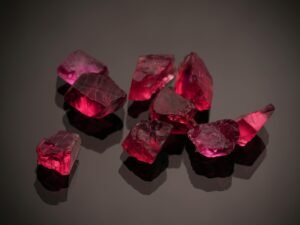
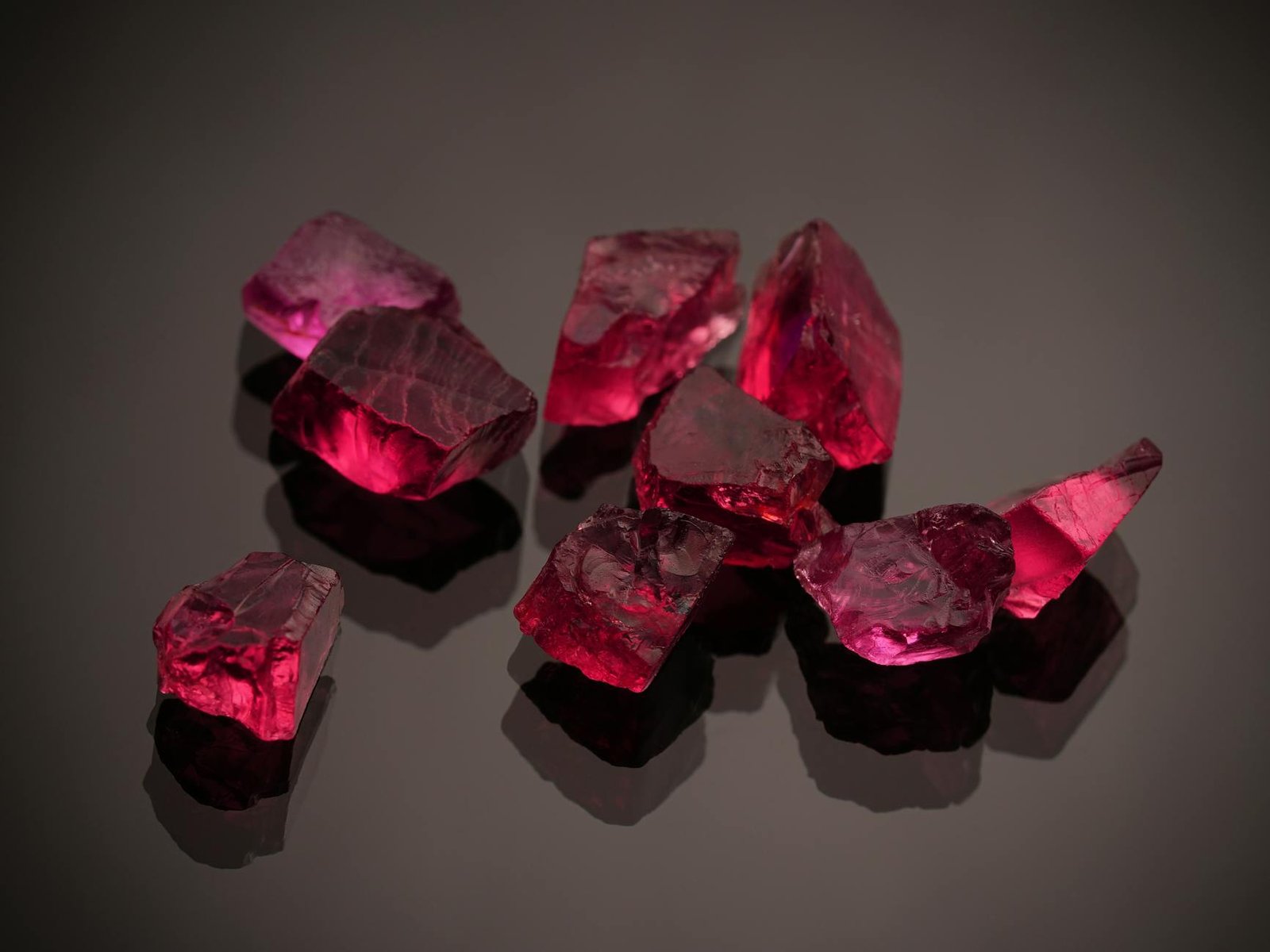
There are gemstones, and then there is the pigeon blood ruby. No other stone in the coloured gemstone canon commands the same reverence, the same sharp intake of breath, the same willingness among collectors to pay prices that rival — and frequently surpass — diamonds of equivalent carat weight. The colour is not merely red. It is a specific, almost otherworldly red: saturated to the edge of excess yet luminous with an inner fluorescence that makes the stone appear to glow from within, as though a flame has been captured inside the crystal and sealed there forever.
The term “pigeon blood colour” originates from the gemological traditions of Burma, where traders observed that the finest rubies from the Mogok Valley held the precise hue of the first two drops of blood drawn from a freshly slaughtered pigeon — a vivid, slightly bluish-red, fully saturated and free of any darkening tone. That description has since been codified by the world’s leading gemological laboratories into a precise colour grade, but the poetry of the original phrase has never lost its power. This is a stone steeped in mythology, history, and extraordinary desire.
At Yala Gems, we have spent years sourcing, grading, and placing these exceptional natural rubies with collectors and connoisseurs across Singapore and beyond. What follows is the definitive guide to understanding, evaluating, and acquiring a pigeon blood ruby — whether you are seeking a single certified loose stone or an exquisite pigeon blood ruby ring for the most important occasion of your life.
- Pigeon blood ruby is the highest colour grade awarded to natural ruby — defined by a vivid, slightly bluish-red saturation with strong fluorescence and no brown or orange modifiers.
- Mogok Valley in Myanmar remains the most prestigious source; Mozambique rubies can also achieve the grade, though typically at a lower price premium.
- Pigeon blood ruby price per carat spans an enormous range — from SGD 8,000 per carat for smaller certified stones to well over SGD 150,000 per carat for unheated Mogok rubies above three carats.
- Origin certificates from Gübelin, GRS, or GIA are non-negotiable for investment-grade purchases; the “pigeon blood” designation must appear explicitly on the report.
- Singapore is one of Asia’s foremost destinations for buying certified natural rubies, with a mature network of trusted dealers and strong consumer protections.
- Whether you buy gemstone online or in person, always demand full provenance documentation and never purchase a pigeon blood ruby without a reputable laboratory certificate.
The Sacred Origins: Mogok and Beyond
Ask any serious collector about pigeon blood ruby location and the answer arrives without hesitation: Mogok. Nestled in the Mandalay Region of Myanmar at an elevation of roughly 1,070 metres, the Mogok Valley has been yielding rubies for over a thousand years. The geology of the region — a unique combination of marble-hosted corundum with extraordinarily low iron content — is directly responsible for the chromium-rich crystals that produce that unmistakable pigeon blood colour. Low iron content means less darkening of the tone; high chromium content drives both the vivid saturation and the exceptional red fluorescence under UV light that makes Mogok stones appear to ignite under sunlight.
The political complexities surrounding Myanmar have made Mogok rubies increasingly difficult to source ethically and legally, which has only intensified their scarcity and driven prices higher. Responsible dealers document the full chain of custody for every stone, ensuring that acquisition does not inadvertently support sanctioned entities. At our Singapore boutique, provenance documentation is treated with the same rigour as the gemological certificate itself.
Mozambique emerged as a significant alternative source following major discoveries in the Montepuez region around 2009. While Mozambique rubies can and do achieve the pigeon blood grade — particularly for their rich saturation — they tend to carry higher iron content, which subtly reduces fluorescence. The trade acknowledges this distinction, and laboratory reports that specify both “pigeon blood” colour and “Mozambique” origin generally command a modest discount relative to equivalent Mogok stones. Vietnam’s Luc Yen region and Tajikistan’s Pamirs have also produced pigeon blood-graded rubies, though in far smaller commercial quantities.
A Mogok ruby with an unheated determination from Gübelin or GRS is among the rarest objects a collector can own. Fewer than five percent of all Mogok rubies submitted to major laboratories receive both the “pigeon blood” colour designation and an “no indications of heating” conclusion simultaneously. When these two qualifiers appear on a single report, the price premium over a heated pigeon blood stone of equivalent weight can exceed 300 percent.
Evaluating the Colour: What Pigeon Blood Really Means

The pigeon blood colour designation is not loosely applied sentiment — it is a rigorously defined grade. GRS (Gemmological Research Switzerland), one of the three laboratories most trusted for ruby grading, defines pigeon blood as a hue of pure red to slightly purplish-red with a vivid saturation level of approximately 95 out of 100 and a tone of roughly 75 out of 100. Critically, there must be no visible brown or orange modifier, and the stone must demonstrate strong red fluorescence. This fluorescence is what creates the glowing quality that separates a true pigeon blood red ruby from an otherwise beautiful but lesser stone.
Beyond colour, a world-class pigeon blood ruby is evaluated on clarity, cut, and carat weight. Unlike diamonds, natural rubies are almost universally included — a completely eye-clean ruby above two carats is extraordinarily rare and commands a steep premium. The most acceptable inclusions are fine rutile silk needles, which actually contribute to a phenomenon called asterism in star rubies, and in faceted stones can slightly scatter light in a pleasing way. Fractures, however, are a serious concern: a ruby treated with lead glass filling to improve apparent clarity is worth a fraction of an untreated stone, and buyers must scrutinise laboratory reports carefully for any disclosure of fracture filling.
Cut quality matters enormously because ruby rough is too valuable to sacrifice to ideal proportions. Most Mogok stones are cut to preserve maximum weight, resulting in high crowns and thick girdles that depart from the ideal. A well-cut pigeon blood ruby that sacrifices perhaps 15 percent of its weight to achieve excellent light return and symmetry is often worth more per carat than a heavier stone with a mediocre cut.
“The pigeon blood ruby does not ask to be noticed. It simply ignites whatever room it enters — and everyone present understands, instinctively, that they are looking at something the earth produces perhaps once in a generation.”
Price Per Carat and the Investment Case
Pigeon blood ruby price per carat is among the most volatile and dramatic pricing structures in the entire natural gemstone market. The price curve is not linear — it escalates exponentially with carat weight, particularly beyond the one-carat and three-carat thresholds. A laboratory-certified pigeon blood ruby of 0.80 carats from Mozambique might trade between SGD 6,000 and SGD 12,000 per carat. Cross into Mogok origin with no heat treatment at two carats and that same per-carat price can reach SGD 60,000 to SGD 90,000. At five carats or above with impeccable provenance, auction records have documented prices exceeding USD 1 million per carat.
| Weight Range | Origin | Heat Treatment | Est. Price Per Carat (SGD) |
|---|---|---|---|
| 0.50 – 1.00 ct | Mozambique | Heated | SGD 5,000 – 12,000 |
| 0.50 – 1.00 ct | Mogok, Myanmar | Heated | SGD 10,000 – 22,000 |
| 1.00 – 3.00 ct | Mogok, Myanmar | Heated | SGD 20,000 – 55,000 |
| 1.00 – 3.00 ct | Mogok, Myanmar | Unheated | SGD 45,000 – 130,000 |
| 3.00 ct+ | Mogok, Myanmar | Unheated | SGD 100,000 – 400,000+ |
The investment case for fine natural ruby has grown considerably stronger over the past two decades. Unlike equities or even most alternative assets, a certified pigeon blood ruby is portable, private, and entirely uncorrelated with financial markets. Auction results at Christie’s and Sotheby’s have consistently demonstrated annual appreciation in the high single digits to low double digits for top-tier stones. The “Sunrise Ruby,” a Mogok pigeon blood ruby of 25.59 carats, sold at Sotheby’s Geneva in 2015 for USD 30.3 million — more than USD 1.18 million per carat, making it the most expensive coloured gemstone ever sold at auction at that time.
Collectors comparing the pigeon blood ruby against other premium coloured stones — including padparadscha sapphire, Paraíba tourmaline, and Kashmir natural sapphire — consistently find that fine ruby has demonstrated the most sustained long-term price appreciation, driven by its combination of extreme rarity, historical significance, and universal cultural desirability across Asian, Middle Eastern, and Western markets alike.
When evaluating pigeon blood stone price as an investment, always factor in the cost of future re-certification. Laboratory reports issued more than ten years ago may not reflect current grading standards, and a fresh report from GRS or Gübelin at the time of resale can meaningfully affect buyer confidence. Budget approximately USD 500–1,500 for re-certification of a significant stone, and store your original report in a climate-controlled safe alongside the stone itself.
Singapore as a Premier Destination for Fine Ruby

For buyers seeking a pigeon blood ruby in Singapore, the city-state offers a genuinely exceptional environment. Singapore sits at the crossroads of the world’s most important ruby supply chains — geographically proximate to Myanmar, Thailand’s cutting centres, and Hong Kong’s trading infrastructure — while maintaining the rule of law, transparent consumer protections, and a mature luxury retail ecosystem that discerning buyers trust. The Singapore jewellery market is also notably free of the pervasive glass-filled ruby problem that plagues less regulated markets, because reputable dealers here understand that a single undisclosed treatment can end a business.
Pigeon blood ruby Singapore buyers benefit from the ability to arrange same-day viewings, compare certified stones side by side under controlled lighting conditions, and consult directly with qualified gemologists before committing to a purchase. This tactile, expert-guided process is irreplaceable for stones at this price point. You will perceive the fluorescence shift between a Mogok stone and a Mozambique stone the moment you move both under a daylight-equivalent lamp — no photograph or video can replicate this experience.
As a gemstone Singapore destination, Yala Gems maintains a curated inventory of certified natural rubies alongside other exceptional coloured stones including natural sapphire, alexandrite, and Paraíba tourmaline. Every stone in our collection is accompanied by a current laboratory certificate from a globally recognised authority. We encourage prospective buyers to speak with our gemologists before any purchase — not as a sales formality, but because an informed buyer is ultimately a more satisfied one.
How to Buy a Pigeon Blood Ruby Online Safely
The ability to buy gemstone online has transformed the coloured stone market, opening access to a far wider inventory than any single city could offer in person. However, the pigeon blood ruby sits at a price point where the risks of an uninformed online purchase are genuinely severe. Sellers operating without physical presence or regulatory accountability have been known to misrepresent treated stones as natural, country of origin, and even stone species altogether. The following principles should govern every online ruby purchase without exception.
First, insist on a current laboratory certificate — not a grading report that is five or ten years old, and not a certificate from an unknown regional laboratory. GRS, Gübelin, and GIA are the three names that carry unambiguous weight in the international market. The report must explicitly state “pigeon blood” as the colour grade, not merely “vivid red.” Second, request a video of the stone under both daylight-equivalent and incandescent lighting to observe fluorescence behaviour and colour shift. Third, confirm the seller’s return and dispute policy in writing before transferring funds. A reputable vendor will offer a transparent return window.
Fourth — and this is the step most online buyers skip — consider having the stone independently re-verified upon receipt by a local gemologist before the return window closes. This single step has saved numerous buyers from costly mistakes. If you are purchasing through our platform, our team is available to speak with our gemologists at any stage of your evaluation process. We also welcome buyers who have sourced stones elsewhere and want a second professional opinion before completing their transaction.
The Pigeon Blood Ruby Ring: Setting a Living Flame
A pigeon blood ruby ring is among the most powerful statements in all of fine jewellery. The stone is inherently emotional — its colour speaks of passion, royalty, and rarity simultaneously — and the right setting either amplifies that power or undermines it entirely. The cardinal rule is that the metal must not compete with the stone. Yellow gold warms the red slightly, pushing it toward orange, which is why many connoisseurs prefer 18-karat white gold or platinum for the finest pigeon blood stones, allowing the pure red to read without interference. Rose gold occupies an interesting middle position, adding warmth without the golden shift.
Prong settings maximise light entry and exit, essential for a stone whose entire appeal depends on luminosity and fluorescence. Bezel settings, while protective, can dull the stone’s brilliance. For engagement rings, a four or six-prong solitaire in platinum remains the most enduringly elegant choice. Flanking the ruby with a natural sapphire or colourless diamond can be extraordinarily beautiful — the contrast of the deep blue sapphire against the vivid red ruby is one of the great classic combinations in fine jewellery history. As a gemstone ring, a pigeon blood ruby solitaire is among the most investment-sound choices a buyer can make — it is simultaneously a wearable luxury and a tangible asset.
Frequently Asked Questions
Final Thoughts
The pigeon blood ruby occupies a singular position among all natural gemstones — it is at once the rarest, the most historically charged, and arguably the most emotionally affecting object that nature produces in crystalline form. Understanding what you are buying, where it came from, how it was treated, and what a fair price looks like is not merely prudent — it is essential at this level of investment. The buyer who takes the time to understand pigeon blood colour grading, the significance of Mogok provenance, and the non-negotiable role of laboratory certification will never overpay and will never be deceived.
Singapore stands as one of the finest places on earth to make this purchase — with its ethical supply chains, sophisticated dealer community, and consumer protections that reward informed buyers. Whether you are drawn to a pigeon blood ruby ring as a declaration of love, a certified loose stone as a portfolio asset, or simply the profound private pleasure of owning one of the rarest objects the earth has ever produced, the journey begins with knowledge. It continues with the right advisor beside you.
Discover Certified Pigeon Blood Rubies at Yala Gems
Explore our curated collection of natural rubies, sapphires, and investment-grade coloured gemstones — each accompanied by full laboratory certification and expert provenance documentation.