

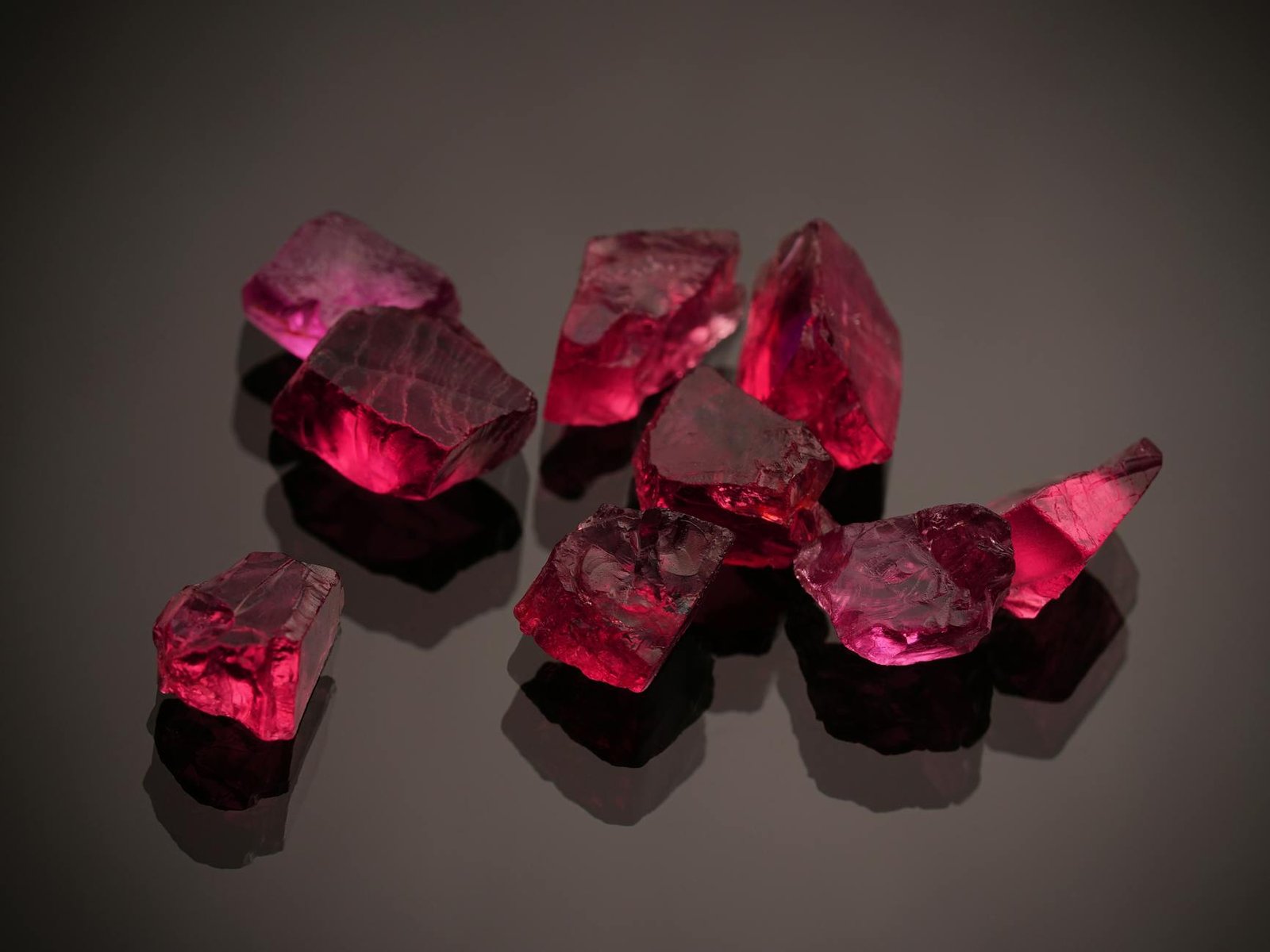
There is a colour so rare, so viscerally alive, that gemologists have spent centuries reaching for language worthy of it. Pigeon blood — the term sounds almost jarring until you see the stone itself. Then, instantly, nothing else will do. A true pigeon blood ruby carries a red of extraordinary saturation: pure, unmodified crimson with a faint blue undertone that lends the gem a luminous, almost self-illuminated quality. It does not merely reflect light. It appears to generate it from within.
Among all natural gemstones, the pigeon blood ruby occupies a singular position. rarer than the finest diamonds, more coveted than even the most exceptional natural sapphire, it represents the apex of the ruby world — a category unto itself. Auction records shatter with quiet regularity when a certified specimen changes hands. Private collectors guard their pieces with the discretion more typical of old masters than of mineral specimens. And buyers who discover this gem for the first time often describe the experience in terms that sound less like shopping and more like falling in love.
At Yala Gems, we have guided discerning buyers through the pigeon blood ruby market for years. This guide distils that expertise into a single authoritative resource — covering origin, quality evaluation, investment merit, pigeon blood ruby price per carat benchmarks, and exactly how to buy with confidence whether you are in Singapore or sourcing from abroad.
- Pigeon blood is the highest colour grade a ruby can receive, defined by a vivid, pure red with a faint blue secondary hue and exceptional fluorescence under UV light.
- The finest specimens originate from Burma (Myanmar), specifically the Mogok Valley, though Mozambique and Sri Lanka also produce certified pigeon blood material.
- Pigeon blood ruby price per carat ranges from approximately USD 5,000 for smaller commercial-grade stones to well over USD 100,000 per carat for untreated Burmese examples above three carats.
- Independent certification from GRS, Gübelin, or GIA is non-negotiable when purchasing any pigeon blood ruby, regardless of price point.
- Singapore’s transparent gem market, GST-inclusive pricing, and proximity to major Asian mining corridors make it one of the world’s most advantageous locations to buy pigeon blood rubies.
- Heat treatment is widespread in the ruby trade; only rubies certified as unheated command true collector-level premiums in the pigeon blood category.
The Origins of Pigeon Blood: Where the Finest Rubies Are Born
The story of pigeon blood red ruby is, at its heart, a story of geology meeting rarity. Rubies form when chromium substitutes for aluminium within the corundum crystal structure — the same mineral family that produces the natural sapphire. When chromium concentrations are high and the crystal grows slowly over millions of years under precise geological conditions, the result is the saturated, vivid red that earns the pigeon blood designation. Those conditions are extraordinarily uncommon.
The Mogok Valley in Upper Myanmar remains the undisputed heartland of pigeon blood ruby production. For over five centuries, Mogok has supplied the royal courts of Asia and Europe with rubies of unmatched colour and clarity. The particular marble-hosted geology of Mogok — low iron content combined with high chromium — suppresses the brownish secondary tones found in many rubies and amplifies both the pure red colour and the characteristic fluorescence that makes a fine Burmese ruby glow under sunlight. A pigeon blood ruby location query almost invariably leads researchers back to Mogok first.
Mozambique emerged as a serious rival in the early 2010s, with the Montepuez deposit producing rubies of genuine pigeon blood quality. Mozambican stones tend toward a slightly stronger blue secondary hue and can exhibit impressive fluorescence, though the finest Burmese material retains a modest but persistent price premium rooted in provenance and legacy. Sri Lankan rubies — rarer in the pigeon blood grade but not unheard of — typically display a softer, more velvety red due to the island’s different host geology. Each origin carries its own aesthetic signature, and connoisseurs often develop strong allegiances to one over another.
When comparing pigeon blood rubies across origins, do not rely on colour photographs alone. The pigeon blood designation is determined by certified gemological laboratories under controlled spectroscopic conditions. A Burmese origin designation from GRS or Gübelin carries significant value beyond sentiment — it is a quantifiable market premium that has held remarkably stable even through broader commodity cycles. Always request a country-of-origin report alongside any colour-grade assessment.
Reading the Stone: How Pigeon Blood Colour and Quality Are Evaluated

The term “pigeon blood colour” refers to a very specific set of measurable optical characteristics, not a loosely applied marketing label. Leading laboratories — GRS, Gübelin, and GIA among them — assess pigeon blood rubies against standardised colour references. The hue must be a strongly saturated, pure red. The tone must sit within a precise mid-to-strong range, avoiding both pallid pinks and overly dark, blood-brick reds. And critically, the saturation must be vivid, with no grey or brown modifying tones to muddy the visual effect.
Fluorescence plays a role that surprises many first-time buyers. Under UV light — and even under the UV component of natural daylight — a genuine pigeon blood ruby exhibits a strong red fluorescence that effectively adds to the apparent colour of the stone. This self-reinforcing optical loop is part of what gives the finest rubies their almost supernatural inner fire. Stones with lower fluorescence, or those with iron inclusions that suppress it, rarely achieve the full pigeon blood grade regardless of their surface colour.
Clarity standards for rubies are more accommodating than for diamonds or fine sapphires. Some degree of silk — fine rutile needle inclusions — is expected and even valued in Burmese material as a provenance indicator. What collectors and buyers must avoid are fractures, particularly those reaching the surface, which compromise both durability and value. A ruby described as “eye-clean” — free of visible inclusions at arm’s length — commands a meaningful premium within the pigeon blood category.
“A pigeon blood ruby does not ask to be noticed. It commands the room before a word is spoken — a red so complete, so uncompromising, that every other stone nearby seems to hold its breath.”
Pigeon Blood Ruby Price Per Carat: What Collectors and Investors Need to Know
Few questions in the gem world generate more confusion than pigeon blood ruby price. The range is genuinely vast, and understanding why requires unpacking several intersecting variables simultaneously. Treatment status, carat weight, origin, clarity, and the issuing laboratory all contribute to price in ways that compound rather than simply add. A single variable — unheated versus heated, for instance — can double or triple the per-carat value of an otherwise identical stone.
As a working benchmark: heated pigeon blood rubies from Mozambique in the one-to-two carat range currently trade between USD 5,000 and USD 15,000 per carat in the retail market. Unheated Burmese pigeon blood rubies in the same size range begin around USD 20,000 per carat and escalate sharply with quality. Above three carats unheated, prices routinely exceed USD 50,000 to USD 100,000 per carat for specimens with strong laboratory reports. At auction — Christie’s, Sotheby’s, Bonhams — exceptional stones have achieved multiples of these figures, with record per-carat prices exceeding USD 1 million for the most extraordinary pieces.
Buyers comparing pigeon blood ruby price per carat in India against Singapore prices will find that the underlying gem values are broadly consistent — rubies are globally traded commodities. The meaningful differences lie in certification standards, duty structures, and the quality of aftercare and provenance documentation available at point of purchase. Singapore’s transparent regulatory environment and the concentration of internationally certified gemologists at boutiques like Yala Gems make it a particularly secure environment for significant purchases.
| Origin | Treatment Status | Carat Range | Approx. Price Per Carat (USD) | Laboratory Grade |
|---|---|---|---|---|
| Burma (Mogok) | Unheated | 1–2 ct | USD 20,000–50,000 | GRS / Gübelin Pigeon Blood |
| Burma (Mogok) | Unheated | 3–5 ct | USD 60,000–150,000+ | GRS / Gübelin Pigeon Blood |
| Mozambique | Heated | 1–2 ct | USD 5,000–15,000 | GRS Pigeon Blood |
| Mozambique | Unheated | 1–2 ct | USD 12,000–30,000 | GRS / GIA Pigeon Blood |
| Sri Lanka | Unheated | 1–2 ct | USD 8,000–20,000 | GRS / Gübelin (rarer grading) |
The investment case for pigeon blood rubies is underpinned by genuine scarcity, not manufactured exclusivity. Global ruby production has declined significantly as legacy deposits in Mogok approach exhaustion. Unlike diamonds, which are produced and distributed through structures that manage supply, fine ruby supply is genuinely constrained by geology. Collectors who acquired certified unheated Burmese pigeon blood material in the 2000s have, in most documented cases, seen substantial real-terms appreciation. As with all hard assets, condition, certification, and provenance documentation are the pillars that support long-term value retention.
Pigeon Blood Ruby in Singapore: Why This City Sets the Standard

Singapore occupies a unique position in the global coloured gemstone trade. Geographically proximate to the major ruby-producing corridors of Southeast and South Asia, it operates under a legal and financial framework that rewards transparency and discourages the opacity that historically plagued parts of the gem trade. For buyers seeking a pigeon blood ruby in Singapore, the practical advantages are considerable and often underappreciated.
GST-inclusive pricing, clear provenance documentation practices, and the availability of internationally accredited gemological expertise combine to make Singapore one of the most buyer-protective environments for significant gem purchases anywhere in Asia. The city’s established relationship with Swiss and international laboratories — GRS, Gübelin, GIA — means that certified stones are readily available and buyers can verify reports directly with issuing labs. This matters enormously when the transaction value runs into tens or hundreds of thousands of dollars.
At our Singapore boutique, we source pigeon blood rubies through relationships built over years with trusted mining region representatives, rough-to-cut specialists, and international auction consignors. Every natural gemstone we present is accompanied by its full laboratory documentation. We also assist buyers in navigating the nuances of SGD-denominated pricing, gem insurance, and ongoing care — services that distinguish a trusted gemstone singapore partner from a transactional vendor. Those ready to explore available stones or seek bespoke guidance are warmly invited to speak with our gemologists directly.
Setting the Standard: The Pigeon Blood Ruby Ring
A pigeon blood ruby ring is among the most powerful statements in fine jewellery. The challenge — and the art — lies in creating a setting that honours rather than competes with the stone’s extraordinary colour. White metals, particularly platinum and white gold, are the most common choices precisely because they reflect the ruby’s red without introducing competing warm tones. The colour contrast is clean, surgical almost, allowing the pigeon blood hue to read at its purest.
Yellow gold settings, by contrast, introduce a warmth that some collectors find deeply romantic — the ruby appears richer, more ancient, more aligned with the Mughal and Burmese court jewellery traditions from which so much of the gem’s mythology descends. The choice of metal is ultimately personal, but it should be made in deliberate conversation with the stone’s specific colour characteristics and secondary hue. A ruby with a stronger blue secondary hue often looks extraordinary in yellow gold, which neutralises any risk of the stone reading cool or violet.
Engagement rings set with pigeon blood rubies have seen a significant rise in demand among buyers who seek meaning alongside beauty — buyers who understand that a ruby’s rarity is not merely a price justification but a genuine reflection of geological improbability. A gemstone ring of this calibre, properly certified and thoughtfully set, becomes an heirloom before it leaves the boutique.
How to Buy Pigeon Blood Ruby Online Safely
The opportunity to buy gemstone online has expanded dramatically over the past decade. So, unfortunately, has the sophistication of misrepresentation. Synthetic rubies, glass-filled stones, and misgraded natural material circulate freely on generalist platforms, and the pigeon blood designation — precisely because it commands premium prices — is among the most abused labels in the online gem market.
The safeguards are clear and non-negotiable. First, demand a current report from GRS, Gübelin, GIA, or an equivalently accredited laboratory. Reports must be verified directly with the issuing laboratory using the report number — every reputable lab provides online verification. Second, buy only from sellers who provide clear provenance documentation and a written return policy. Reputable dealers operating in Singapore’s regulated market will offer both without hesitation. Third, understand that if a price appears dramatically below market benchmark for a certified pigeon blood ruby, it almost certainly signals a problem with either the stone or the documentation.
Yala Gems provides a secure, fully documented pathway to buy pigeon blood ruby for clients in Singapore and internationally. Our buy gemstone online process includes video consultations with our gemologists, high-resolution imagery under multiple lighting conditions, and full laboratory report verification before any transaction is finalised. We encourage every prospective buyer to speak with our gemologists before committing to any significant ruby purchase, wherever the stone originates.
Frequently Asked Questions
Final Thoughts
The pigeon blood ruby stands apart not merely because of its rarity, though the rarity is extraordinary. It stands apart because it provokes a response in people that very few objects in the world can match — a recognition that is almost pre-rational, immediate, and absolute. When colour, light, geology, and human craft converge at this level, the result transcends jewellery and becomes something closer to a permanent argument for beauty.
Whether you are approaching this gem as a collector, an investor, a prospective bride or groom, or simply someone who has encountered the stone and found themselves unable to look away, the principles that govern a wise purchase remain constant. Certification from a globally accredited laboratory. Verified provenance. A seller whose expertise and transparency you can confirm. These are not bureaucratic formalities — they are the foundations on which a purchase of this significance must rest.
Singapore offers a uniquely favourable environment for that purchase, combining regulatory rigour with genuine gemological depth and proximity to the world’s finest source material. As a trusted gemstone singapore partner, Yala Gems is committed to guiding every client through this process with the same care we would apply to our own collection — because we understand that a pigeon blood ruby, once acquired, is rarely acquired again. It becomes, instead, something you pass on.
Ready to Find Your Pigeon Blood Ruby?
Explore our curated knowledge resources or connect with our certified gemologists for personalised guidance on certified natural rubies and gemstone rings in Singapore.


