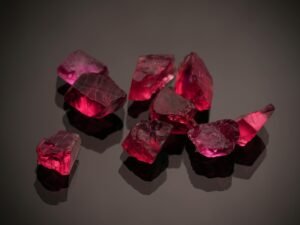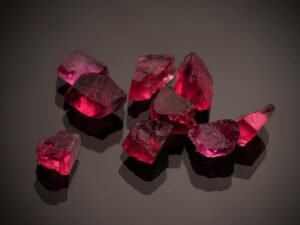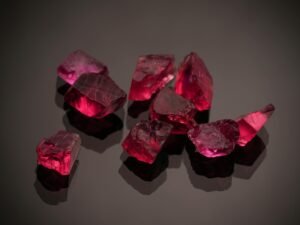

There are gemstones, and then there is the pigeon blood ruby. No other stone in the canon of fine jewellery commands quite the same reverence — a combination of geological rarity, chromatic perfection, and centuries of royal mythology that places it entirely in a category of its own. When a ruby earns the designation “pigeon blood,” it is not merely a colour description. It is a credential, whispered between gemologists and bid upon fiercely at the world’s most prestigious auction houses.
The pigeon blood colour is famously difficult to define with clinical precision, which is precisely why it captivates so completely. Imagine the most saturated, vivid red you have ever seen — then imagine it lit from within, carrying a faint blue undertone that deepens the hue without darkening it. Gübelin, the legendary Swiss laboratory, describes it as a red of “uncompromising intensity with a hint of blue,” a definition that still feels inadequate the moment you hold one of these stones under natural light. The colour does not sit on the surface; it radiates.
At Yala Gems, we have spent years sourcing exceptional natural rubies for discerning collectors and couples across Singapore and beyond. We understand that buying a pigeon blood ruby is not a transaction — it is an acquisition. This guide is written to give you the knowledge you deserve: the geology, the grading, the pricing reality, and the confidence to make a purchase you will treasure across generations.
- A pigeon blood ruby is a natural ruby displaying an intensely saturated, vivid red with a slight blue fluorescent undertone — the rarest and most valuable colour grade in the ruby market.
- The finest specimens originate from Mogok, Myanmar, though significant sources also exist in Mozambique, Madagascar, and Sri Lanka.
- Pigeon blood ruby price is driven by origin, fluorescence, clarity, cutting precision, and the presence of a credible laboratory certificate from GIA, Gübelin, or SSEF.
- Top-quality stones regularly exceed USD 1 million per carat at auction, while commercial-grade examples with the designation can be acquired from USD 3,000–15,000 per carat for one-carat stones.
- Singapore has emerged as Southeast Asia’s foremost destination for acquiring certified, natural ruby and other fine gemstones, combining trusted provenance with competitive access to the global market.
- Whether you choose to buy gemstone online or visit a boutique in person, certification and sourcing transparency are non-negotiable when purchasing at this level.
Where Pigeon Blood Rubies Come From
The story of the pigeon blood ruby begins in the Mogok Valley of upper Myanmar, a remote stretch of mountainous terrain that has been producing the world’s most extraordinary rubies for over a thousand years. The geological conditions here are extraordinarily specific: marble-hosted corundum deposits rich in chromium, combined with low iron content, produce stones that fluoresce brilliantly under ultraviolet light and ultraviolet-rich daylight alike. It is this fluorescence — essentially the stone glowing against itself — that gives Mogok rubies their unmatched vivid fire.
Iron suppresses fluorescence in corundum, which is why rubies from iron-rich deposits elsewhere rarely achieve true pigeon blood saturation. Mogok’s marble environment has almost no iron, allowing chromium to dominate entirely. The result is a stone that appears to pulse with internal light. When gemologists say a pigeon blood red ruby “glows,” this is not poetic licence — it is measurable physics.
Mozambique has emerged in recent decades as a credible second source. Stones from the Montepuez deposit can achieve the pigeon blood designation through laboratory testing, and their strong fluorescence occasionally rivals Mogok at a more accessible price point. Madagascar and Greenland contribute smaller quantities of qualifying stones. However, among serious collectors, a Mogok origin with a laboratory-confirmed pigeon blood grade remains the singular pinnacle.
The term “pigeon blood” has an origin story as poetic as the stones themselves. Traditional Burmese traders described the colour as resembling the first two drops of blood from a freshly killed pigeon — vivid, slightly translucent, and never darkening toward maroon or brick red. Today, major laboratories including GIA, SSEF, and Gübelin have codified the designation using spectroscopic measurement, fluorescence analysis, and colour coordinates, making it an objective — not purely subjective — quality grade.
Understanding Pigeon Blood Colour and Quality Evaluation

So, what colour is a pigeon blood ruby, precisely? The Gemological Institute of America describes the target hue as a pure red with very slightly purplish modifying tones, a saturation grade of “vivid,” and a tone that sits in the medium to medium-dark range — never so dark it loses transparency, never so light it reads as pink. The faint blue or purple modifier is crucial: it prevents the stone from reading as orange-red (which would place it closer to spinel) and contributes to the perception of depth.
What does a pigeon blood ruby look like in person? The experience is immediate and visceral. There is no lag between looking and knowing. The stone demands attention with an urgency that paler rubies, however lovely, simply cannot replicate. Under incandescent light, the red intensifies further, almost appearing to breathe. Under daylight, the fluorescence activates and the colour seems to lift off the surface entirely.
Beyond colour, quality evaluation encompasses several equally critical factors. Clarity is assessed on a scale that accounts for the inclusions typical in corundum — silk (fine rutile needles), fingerprints, and healing fractures are expected and acceptable, but eye-visible fractures that threaten durability or heavily interrupt the colour are penalised. Cutting quality matters enormously: a poorly proportioned stone loses the brilliance that makes pigeon blood rubies so legendary. Carat weight amplifies value exponentially — a two-carat pigeon blood stone does not cost twice a one-carat stone; it may cost five to ten times more.
Heat treatment is an almost universal reality in the ruby market. The vast majority of rubies — including many certified pigeon blood stones — have been heated to dissolve silk inclusions and improve clarity. A heated ruby is not a lesser ruby, provided the treatment is disclosed and documented. What does command an extraordinary premium is an unheated pigeon blood ruby with a clean certificate — these are among the rarest natural gemstone offerings on earth.
Pigeon Blood Ruby Price and Collector Value
Understanding pigeon blood ruby price requires abandoning the standard per-carat frameworks that apply to commercial gemstones. At the very top of the market — fine Mogok stones above three carats, unheated, with GIA or Gübelin pigeon blood confirmation — prices have reached USD 1.18 million per carat at Sotheby’s and Christie’s. These are not outliers; they reflect a sustained, decade-long appreciation in the value of the finest natural ruby material.
For buyers approaching this category for the first time, more accessible entry points exist without sacrificing legitimacy. A certified pigeon blood ruby in the 0.5–1.0 carat range with heat treatment and strong colour can be acquired in the USD 3,000–15,000 per carat range from a reputable dealer. A one-carat pigeon blood ruby ring price in Singapore, set in 18-karat gold with modest side stones, might realistically begin around SGD 8,000–25,000 depending on the specific stone’s characteristics. Exceptional examples with larger stones or unheated certificates command significantly more.
“A pigeon blood ruby does not depreciate in the way that financial assets can. It appreciates through scarcity — Mogok is finite, buyer demand is global, and the number of truly qualifying stones produced each year can be counted in hundreds, not thousands.”
Collector value is underpinned by three structural realities. First, the supply of Mogok material is genuinely contracting as historical deposits are exhausted. Second, institutional buyers — auction houses, sovereign wealth-aligned collectors, and museum-quality private collections — compete aggressively for top-tier stones, creating a price floor that individual buyers benefit from. Third, the pigeon blood designation itself functions as a liquidity mechanism: a certified stone is universally understood and tradeable in any major jewellery market globally.
| Origin | Pigeon Blood Grade Frequency | Fluorescence | Relative Price (per carat) | Laboratory Recognition |
|---|---|---|---|---|
| Mogok, Myanmar | Highest | Very Strong | USD 5,000–1,000,000+ | GIA, Gübelin, SSEF |
| Montepuez, Mozambique | Moderate | Strong | USD 2,000–80,000 | GIA, Gübelin, SSEF |
| Madagascar | Low–Moderate | Moderate | USD 1,500–30,000 | GIA, Gübelin |
| Sri Lanka | Rare | Moderate–Strong | USD 2,000–50,000 | GIA, Gübelin, GRS |
| Vietnam (Luc Yen) | Low | Moderate | USD 1,500–25,000 | GIA, Gübelin |
Singapore as a Premier Destination for Natural Ruby

Singapore occupies a unique position in the global fine gemstone market. Its geographic proximity to the producing regions of Myanmar, Sri Lanka, and Madagascar — combined with its status as a trusted international trading hub with robust consumer protection laws — makes it one of the most advantageous places on earth to acquire a significant natural gemstone. Pigeon blood ruby Singapore buyers benefit from a market where both provenance documentation and competitive pricing coexist in ways rarely possible in Western retail environments.
The gemstone Singapore ecosystem has matured considerably over the past two decades. Local dealers now regularly source from the Mogok Valley through established channels, and laboratory certification — once considered optional by some regional traders — is now a baseline expectation among informed Singapore buyers. This shift has elevated the quality of stones available locally and made the city-state a genuinely world-class destination for serious acquisition.
At Yala Gems, our buying philosophy centres on full traceability. Every pigeon blood ruby we present carries laboratory documentation from GIA, Gübelin, or SSEF, and we are transparent about treatment status, origin determination, and colour grade methodology. We are happy to speak with our gemologists about any stone you are considering — whether you are purchasing a pigeon blood engagement ring for a milestone moment or building a long-term collection.
Comparing a pigeon blood ruby to a natural sapphire — another corundum variety — illustrates how dramatically origin and colour grade affect value within the same mineral family. A fine Kashmir or Ceylon sapphire commands enormous premiums for similar reasons: a laboratory-confirmed origin, an exceptional colour designation, and a finite supply. The mechanisms that make both categories valuable are identical. Educated buyers often diversify across both, treating them as complementary rather than competing acquisitions.
The Pigeon Blood Engagement Ring
There is something deeply resonant about choosing a pigeon blood ruby for an engagement ring. The colour red has been associated with passion, commitment, and life itself across every culture and civilisation that has valued fine stones. Where a diamond engagement ring communicates purity and eternity, a pigeon blood ruby ring communicates ardour — something almost dangerously alive.
Practically speaking, ruby is an excellent choice for a gemstone ring intended for daily wear. With a Mohs hardness of 9 — second only to diamond — it resists scratching and surface wear exceptionally well. A well-set pigeon blood ruby ring in a protective bezel or raised prong setting will endure decades of wear without compromising the stone’s integrity. Paired with platinum or 18-karat white gold, the colour contrast is electric. Set in yellow or rose gold, the warmth of the metal amplifies the red to almost theatrical effect.
Those considering a pigeon blood engagement ring should approach the process with the same rigour they would apply to any significant asset acquisition. Establish your budget range honestly, prioritise colour and certification above carat weight if a trade-off is required, and work exclusively with dealers who provide full documentation. A 0.80-carat pigeon blood stone with vivid colour and a clean certificate will outshine a 1.5-carat stone of ambiguous origin and grade every time — in the light and in the market.
How to Buy Gemstone Online Safely at This Level
The rise of digital platforms has made it possible to buy gemstone online at investment grades — but it has also created significant risk for buyers who do not know what documentation to require. The pigeon blood designation in particular has been misused in online marketplaces where sellers apply the term loosely, without laboratory backing, to inflate pricing on ordinary commercial rubies. Protecting yourself begins with understanding exactly what a legitimate purchase looks like.
Always require a current laboratory certificate — issued within the past three to five years — from GIA, Gübelin, SSEF, or GRS. The certificate should explicitly state “pigeon blood” as a colour quality designation, not merely “vivid red.” It should also state the origin determination (Mogok, Mozambique, etc.) and disclose any heat treatment. A certificate number should be verifiable directly on the issuing laboratory’s website. Any seller who cannot provide this documentation for a stone marketed at pigeon blood prices should be disqualified immediately.
Video is essential when you buy gemstone online at this tier. Request high-resolution footage under both daylight-equivalent and incandescent lighting, as well as footage showing the stone loose and in any proposed setting. Reputable dealers will provide this without hesitation. At Yala Gems, our team is always available to speak with our gemologists to walk you through a stone’s characteristics in real time, whether you are based in Singapore or purchasing from abroad.
Return policies matter. A legitimate dealer offering natural gemstone at significant price points will provide a reasonable return window and, ideally, an independent appraisal guarantee. This is not paranoia — it is the standard of care that distinguishes professional fine gem dealing from retail trading. The pigeon blood ruby ring price singapore buyer intent searches are among the most competitive in the regional market precisely because demand is high and supply of genuinely certified stones is limited. Do not let urgency override diligence.
Frequently Asked Questions
Final Thoughts
The pigeon blood ruby stands apart not because of tradition or marketing, but because of a geological miracle that no human process can manufacture or shortcut. When the chromium content is right, the iron is absent, and the Mogok marble has done its slow, magnificent work over millions of years, the result is a stone that changes how you think about colour itself. It is not the reddest thing you have ever seen. It is the most alive.
Acquiring one demands patience, education, and a relationship with a dealer you genuinely trust. The documentation must be rigorous, the sourcing must be transparent, and the decision must be yours — made with full information rather than urgency or impulse. Whether you are drawn to a pigeon blood ruby ring as a declaration of love, a pigeon blood engagement ring as a symbol of commitment, or a loose stone as the cornerstone of a serious collection, the criteria for a wise acquisition remain identical.
At Yala Gems, we believe that the finest natural gemstone should be accompanied by the finest buying experience. We curate every stone we offer with the same exacting standards we would apply to our own collections, and we are committed to ensuring that every client — whether they choose to buy gemstone online or visit us in Singapore — leaves with complete confidence in what they have acquired.
Deepen Your Gemstone Knowledge
From ruby origins to certification standards, our editorial library covers everything the informed buyer needs to know.