Description
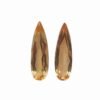
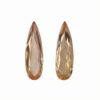
Among the most coveted of all precious stones, Imperial Topaz occupies a singular place in the collector’s lexicon — its rich golden-orange saturation, historically sourced from the celebrated Ouro Preto mines of Brazil, has commanded the attention of serious gem enthusiasts for centuries. This 10.20-carat specimen presents the depth of colour and crystalline clarity that defines the imperial designation, a grade reserved only for topaz exhibiting that distinctive warm, cognac-kissed orange with subtle peachy or reddish overtones. At this carat weight, the stone enters a scale where fine examples become genuinely scarce, making thoughtful acquisition a matter of both connoisseurship and foresight.
| Name |
Imperial Topaz 10.20 cts |
Frequently Asked Questions
What distinguishes Imperial Topaz from other varieties of topaz?
Imperial Topaz is defined by its warm orange body colour, often carrying secondary pink, red, or sherry-gold overtones — a chromatic profile entirely distinct from the blue or colourless topaz commonly found in the mass market. The ‘imperial’ classification is not simply a marketing term; it reflects a genuine rarity in the mineral’s natural colour range, historically tied to stones from the Minas Gerais region of Brazil. Collectors and gemmological institutions reserve this designation strictly for topaz exhibiting this specific warm hue at meaningful saturation.
How does colour saturation affect the value of Imperial Topaz at this carat weight?
In Imperial Topaz, colour is the primary value driver — stones exhibiting a medium-strong to strong orange saturation with rose or reddish modifiers command the highest premiums among informed collectors. At 10.20 carats, the relationship between saturation and value becomes particularly pronounced, as the additional crystal mass allows colour depth to develop fully through the stone rather than appearing washed or uneven. Fine examples at this weight with consistent, well-distributed hue are meaningfully rarer than smaller calibrated goods and are priced accordingly in the specialist market.
Does Imperial Topaz display any optical phenomena, and what are its key physical properties?
Imperial Topaz does not typically exhibit optical phenomena such as asterism or chatoyancy, but its exceptional brilliance stems from its high refractive index of approximately 1.619–1.627 and strong dispersion, which together produce a lively, light-filled optical character. It belongs to the orthorhombic crystal system and registers 8 on the Mohs hardness scale, making it among the harder gem-quality minerals. Collectors should note that topaz has perfect basal cleavage in one direction, a structural characteristic that informs both cutting decisions and long-term handling protocols.
What care practices and certifications should a collector prioritise for Imperial Topaz?
Imperial Topaz should be stored away from prolonged exposure to strong light and heat, as extended ultraviolet exposure can cause the colour of some specimens to fade over time — a factor worth documenting at the point of acquisition. Cleaning is best performed with lukewarm water and a soft brush, avoiding ultrasonic or steam cleaners that could exploit the stone’s cleavage plane under vibration or thermal stress. For investment-grade specimens, a laboratory report from a recognised authority such as GIA, Gübelin, or SSEF is essential, as it provides independent verification of natural colour origin, treatment status, and weight — documentation that underpins long-term provenance and resale confidence.







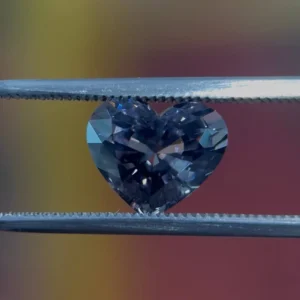 Natural Grey Spinel | 2.46 ct Heart Shape
Reviews
There are no reviews yet.